

The thread: 708 → 710 → 711 → 712
Stay on level 1 of the Denon wing. This route does not try to summarise all Italian painting at the Louvre; it connects four rooms around works that each carry their own collection history, from a court commission to a painting rejected by the Church.
Begin in the Salon Carré, room 708, then follow the Grande Galerie through rooms 710, 711 and 712.
1. Room 708 — Botticelli, a Virgin from Faenza
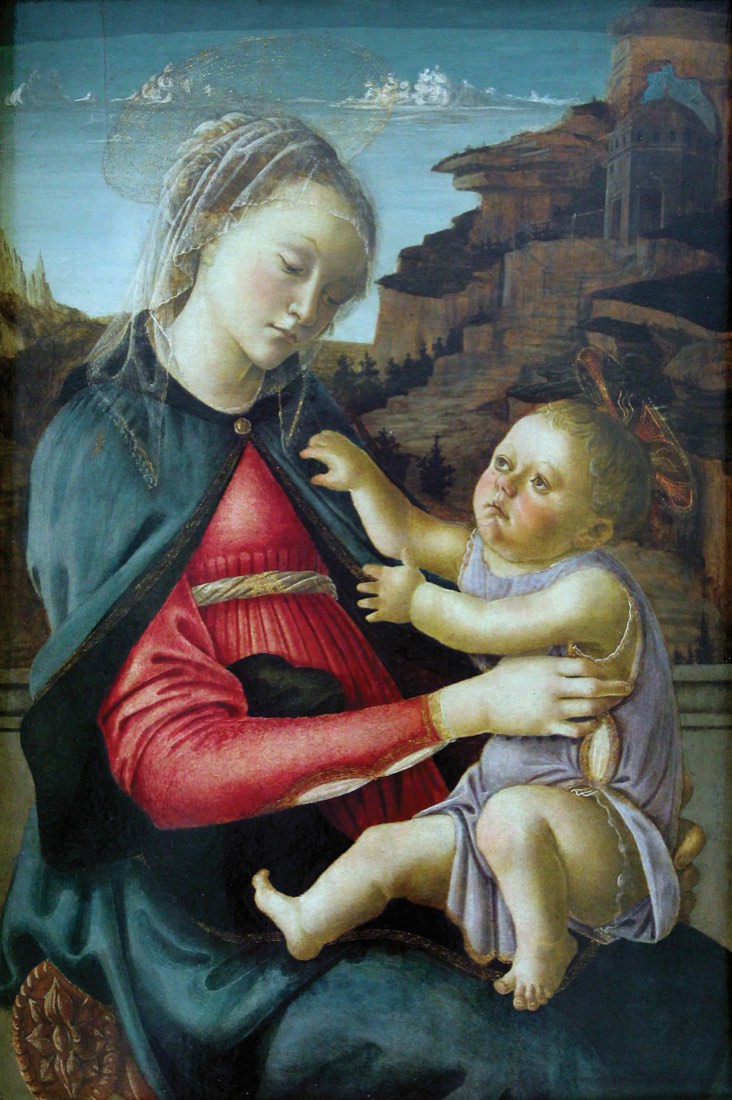
The Virgin and Child, known as the Madonna of the Guidi of Faenza, by Sandro Botticelli, is a tempera on poplar wood measuring 73 by 49.5 centimetres, dated to the third quarter of the 15th century (1450-1475). The scale is intimate: step close, this was not painted to be seen from a distance.
Its name comes from the Museo Guidi in Faenza, Italy, where it hung before being sold at auction in Rome in 1902. It then entered the collection of Baron Basile de Schlichting, a Paris-based collector, who bequeathed it to the Louvre on his death in 1914 — a gift, not a seizure or a royal purchase, which sets it apart from the rest of this route.
In the same room, the Portrait of a Man, also by Botticelli, entered the Louvre in 1882, bought from a private collector through the auctioneer Ch. Pillet. It was then catalogued as an anonymous work of the 15th-century Florentine school, attributed for a time to Filippo Lippi, before finally being given to Botticelli — the sitter's identity, meanwhile, has never been recovered. A thin red painted border, still visible around the composition, marks the probable edge of the original frame.
2. Room 710 — Mantegna paints a marchioness’s love story
Parnassus, also known as Mars and Venus, was commissioned from Andrea Mantegna in the winter of 1496-97 by Isabella d’Este, Marchioness of Mantua, to decorate her studiolo at the Castello di San Giorgio. The scene of Mars and Venus’s love works as allegory: Isabella had married Marquis Francesco II Gonzaga in 1490, and the painting celebrates the ruling couple as much as the muses of their court.
It was the first canvas delivered for this private study, a decorating project Isabella pursued for more than twenty years. Some repainting — the landscape, Venus’s figure, the heads of Apollo and several muses — is now attributed to a painter of the next generation, Lorenzo Leonbruno.
3. Room 711 — The contest Tintoretto fought against Veronese
The Coronation of the Virgin, known as Paradise, is the sketch Tintoretto submitted in 1582 for a fiercely contested commission: decorating the Grand Council Hall of the Doge’s Palace in Venice. His rivals were none other than Veronese, Francesco Bassano, Palma the Younger and Federico Zuccaro — the scene was meant to hang above the doge’s throne.
The canvas, 1.43 by 3.62 metres, later belonged to the Bevilacqua family in Verona, recorded in their inventories from 1593. It was taken from the Palazzo Bevilacqua in 1797 and entered the Louvre the following year, in 1798 — the same wartime route as several other paintings on this route.
4. Room 712 — A portrait with no sitter, a Virgin rejected by the Church
The Portrait of a Young Man Holding a Statuette was bought by Louis XIV in 1671 from the banker Everhard Jabach. At the time it was attributed to Sebastiano del Piombo and believed to show the sculptor Baccio Bandinelli.
Both identifications turned out to be wrong: the painting, made around 1550, is now given to Bronzino, but the young man’s identity remains a genuine open question for art historians. The current, deliberately neutral title reflects that.
Nearby, Caravaggio's Death of the Virgin, finished in late 1605 or early 1606, was commissioned by Laerzio Cherubini for the church of Santa Maria della Scala in Rome — then rejected by its clergy: the Virgin's slumped body and bare, swollen feet shocked with their raw realism. The contemporary biographer Giulio Mancini reported that Caravaggio had used a prostitute, perhaps his own mistress, as his model. The painting was bought as early as 1607, on Rubens's recommendation, by Duke Ferdinando Gonzaga of Mantua, before passing through the collection of Charles I of England, then through the same dealer, Everhard Jabach — and entering, like the neighbouring Bronzino, the collection of Louis XIV in 1671.
5. Room 712 — Raphael, the portrait of a writer friend
The Portrait of Baldassare Castiglione, painted by Raphael around 1514-1515, is an oil on canvas measuring 82 by 67 centimetres. The sitter (1478-1529), a writer and diplomat, wrote The Book of the Courtier and was a friend of Raphael; the portrait comes from the Casa Castiglione in Mantua.
According to the Louvre’s record, its owners included the Duke of Urbino, the Grand Duchess of Tuscany and the Amsterdam dealer L. van Uffelen. Cardinal Mazarin owned it by 1661 at the latest; Louis XIV obtained it from Mazarin’s heirs in 1665 and added it to the royal collection.
6. Room 712 — Caravaggio, a fortune-teller and a stolen ring
The Fortune Teller, painted by Caravaggio around 1595-1598, is an oil on canvas measuring 99 by 131 centimetres. A Romani woman reads the palm of an elegant young man and, while doing so, discreetly steals his ring: a genre scene taken from the street, often read as a warning against false prophecy and self-interested seduction.
Two versions exist, very close in composition: the Louvre’s and the one in the Capitoline Museums in Rome, which came from Cardinal del Monte’s collection. The Louvre painting passed through the Roman collector Alessandro Vittrici, then the Doria-Pamphili family; Prince Camillo Pamphili gave it to Louis XIV in 1665, and it appears in the royal inventory of 1683.
How much time
Eight works across four rooms: do not rush, each one rewards a long look.
- Madonna of the Guidi of Faenza (Botticelli) — 8 minutes.
- Portrait of a Man (Botticelli) — 5 minutes.
- Parnassus (Mantegna) — 10 minutes.
- Paradise (Tintoretto) — 8 minutes.
- Portrait of a Young Man Holding a Statuette (Bronzino) — 8 minutes.
- Death of the Virgin (Caravaggio) — 10 minutes.
- Portrait of Baldassare Castiglione (Raphael) — 6 minutes.
- The Fortune Teller (Caravaggio) — 6 minutes.
Sources and verification
The rooms, dates, dimensions and histories cited here were checked against Louvre records.
- Louvre Collections: Madonna of the Guidi of Faenza
- Louvre Collections: Portrait of a Man (Botticelli)
- Louvre Collections: Mantegna’s Parnassus
- Louvre Collections: The Coronation of the Virgin, known as Paradise
- Louvre Collections: Portrait of a Young Man Holding a Statuette
- Louvre Collections: Death of the Virgin (Caravaggio)
- Louvre Collections: Portrait of Baldassare Castiglione (Raphael)
- Louvre Collections: The Fortune Teller (Caravaggio)
Displays and room openings can change. Check the Louvre website on the day of your visit before following a route.
Continue your visit
The Louvre
Listen to the commentary in the gallery
This route gives you a thread to follow. In front of an artwork, CulturAll adds the audio commentary: photograph the work or its label, listen, then ask your questions.