

The Italian Renaissance in one Ashmolean room
This room brings together Italian paintings from the fifteenth and early sixteenth centuries, from Paolo Uccello to Titian by way of Giovanni Bellini, Piero di Cosimo and Domenico Ghirlandaio — a collection that lets you trace, in a few steps, the evolution of painting in Tuscany, Umbria and the Veneto over nearly a century.
1. A night hunting scene, the painter's last known work
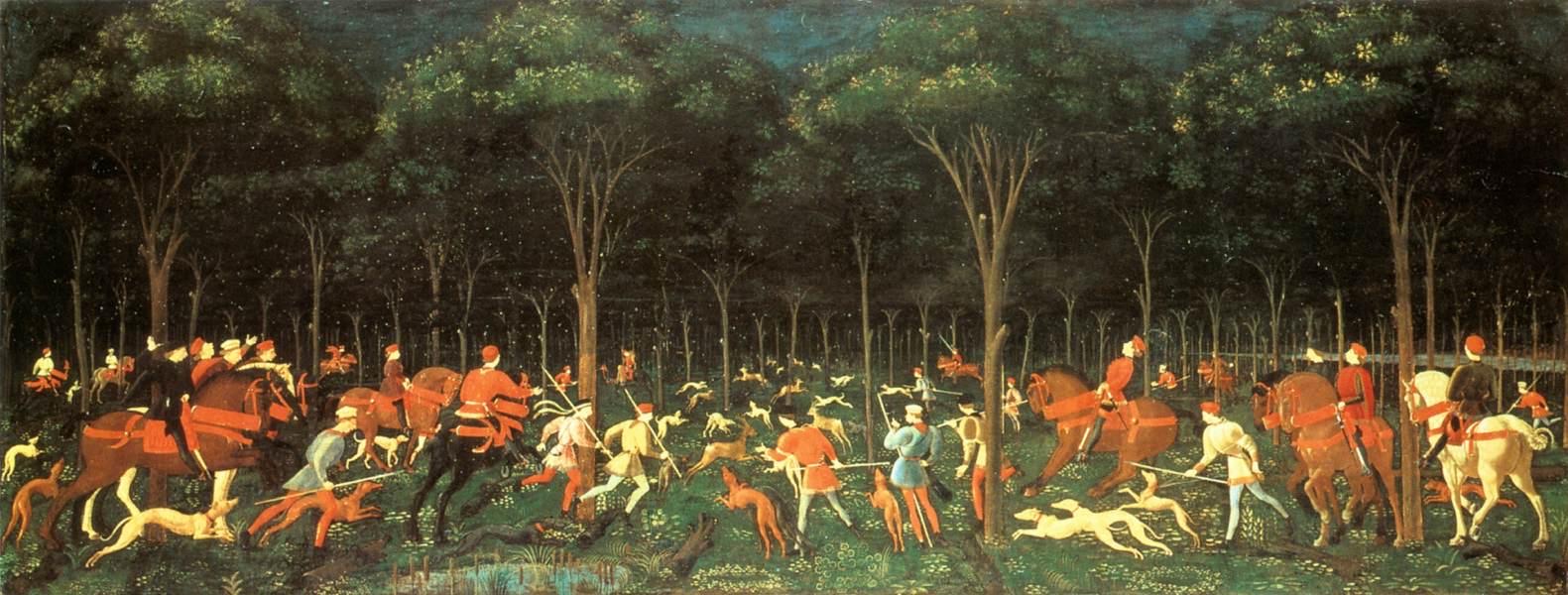
The Hunt in the Forest, painted by Paolo Uccello around 1470, shows a night hunt organized with almost obsessive perspectival rigor: hunters, horses and dogs shrink methodically toward a single vanishing point, deep in a dark forest lit by an almost unreal light. The elongated panel probably belonged to a marriage chest, or a set of paneling meant to be viewed at shoulder height rather than hung high on a wall.
It is Uccello's last known work; he died in 1475, a painter who remained fascinated by linear perspective his whole life, to the point that his contemporaries already described him as obsessed with this emerging discipline.
2. A Madonna still contested by three painters
The Virgin and Child with a View of Venice, known as the "Tallard Madonna," painted between 1506 and 1513, shows the Virgin and Child before a hazy landscape in which the campanile of St Mark's Square in Venice can be made out. Long attributed to Giorgione, the painting now carries a more cautious attribution, shared between Giorgione himself, his contemporary Sebastiano del Piombo, and the Venetian painter Giovanni Cariani — a debate still open, and a good illustration of how hard early sixteenth-century Venetian workshops make it to tell a master's hand from that of his close collaborators.
3. Bellini and Piero di Cosimo, two founding landscapes
Giovanni Bellini's Saint Jerome Reading in a Landscape, painted around 1480-1490, shows the saint retired to the Syrian desert, accompanied by the lion from whose paw he once removed a thorn, absorbed in reading the Bible he would translate into Latin. In the distance, a walled city recalls Venice's mainland territories more than ancient Syria. The attribution to Bellini himself remains debated — some historians have proposed Andrea Previtali or Vittore Carpaccio — but the composition almost certainly derives from his invention.
Piero di Cosimo's The Forest Fire, painted around 1505, shows a multitude of frightened animals, real and imagined, fleeing a raging forest fire. Drawing on Book 5 of Lucretius's poem On the Nature of Things, this panel counts among the very first Renaissance landscapes conceived as a subject in its own right rather than a mere backdrop.
4. Titian and Ghirlandaio, love and portraiture
Titian's The Triumph of Love, painted around 1543-1546, shows Cupid armed with his bow taming a crouching lion — a classical allegory of love overcoming the wildest passions. The panel originally served as a protective cover for a portrait of a noblewoman Titian painted for the Vendramin collection, a practical function now largely forgotten in front of the one image that survives.
Domenico Ghirlandaio's Portrait of a Young Man, painted around 1477-1478, shows an unidentified sitter in a portrait format then recently popularised by Flemish painting. Ghirlandaio, trained as a goldsmith before becoming one of the most sought-after Florentine painters of the late fifteenth century, would later count the young Michelangelo among his pupils.
5. Allori, the last echo of Bronzino in this room
Alessandro Allori's Portrait of a Young Man, painted around 1560 shortly after his return from Rome, where he had studied ancient and modern art between 1554 and 1560, shows a young man with an air of refined hauteur, pausing while polishing a medal to display it to the viewer — it bears the profile of a woman in classical dress. His identity remains uncertain: proposed candidates include Paolo Capranica, related to the Della Valle family, or a member of the Conti Palma family.
A pupil of Bronzino, Allori shares his master's taste for a cool, distant elegance, reinforced here by the sitter's own gesture: a young man surrounding himself with antique-style objects, as the refined collectors of Medicean Florence did in his day. It is the latest painting in this room, nearly a century after Uccello's Hunt in the Forest.
6. Room 42, next door — a young Uccello’s Annunciation, a Fra Angelico and a Bellini
In the neighbouring room (Room 42, “Early Italian Art”), Paolo Uccello’s Annunciation (early 1420s, tempera and gilding on panel, 65 × 48 cm) is one of his very first paintings: the angel Gabriel announces to Mary that she will bear the son of God (Luke 1: 26-28). Part of the Fox-Strangways Gift of 1850, it was long attributed to other artists and was only returned to Uccello in 1980, through comparison with his Beccuto Madonna. Recent examination has revealed a lively underdrawing with pentimenti — including a change in the position of the Holy Spirit — and a lavish use of gold and ultramarine.
Fra Angelico’s Crucifixion with the Virgin, Saint John the Evangelist and the Magdalen (early 1420s, tempera on gold-ground panel) spent about two centuries in a British private collection before being recognised as a work by Fra Angelico in 1996. The museum acquired it through a fundraising campaign supported by the National Heritage Memorial Fund, the Art Fund and many donors. The Virgin gazes outward in tears; at the top of the cross a pelican feeds her young with her own blood, a symbol of Christ’s sacrifice; the verdant tree suggests hope and new life after death.
Giovanni Bellini’s Virgin and Child (late 1460s – early 1470s, tempera and gilding on panel, 33.5 × 27.2 cm) was accepted by HM Government in lieu of inheritance tax from the estate of Lord Clark of Saltwood and allocated to the Ashmolean in 1987. The gold ground dates from the early twentieth century, and the figures may originally have been set against a curtain or a landscape; heavily restored, it has been placed back in a tabernacle frame thanks to the Fondation Etrillard.
How much time
Two puzzles to start — the construction of Uccello's panel, the authorship of the Tallard Madonna — then five more paintings tracing a century of Italian art, and three works from the next room. Allow about an hour and a quarter for all of it.
- Background on the room — 5 minutes.
- The Hunt in the Forest (Uccello) — 8 minutes.
- The Tallard Madonna — 6 minutes.
- Saint Jerome Reading in a Landscape (Bellini) — 6 minutes.
- The Forest Fire (Piero di Cosimo) — 6 minutes.
- The Triumph of Love (Titian) — 6 minutes.
- Portrait of a Young Man (Ghirlandaio) — 6 minutes.
- Portrait of a Young Man (Allori) — 6 minutes.
- The Annunciation (Uccello, Room 42) — 7 minutes.
- The Crucifixion (Fra Angelico, Room 42) — 6 minutes.
- The Virgin and Child (Bellini, Room 42) — 5 minutes.
Sources and verification
Checked against the official notices of the Ashmolean Museum (ashmolean.org) and cross-checked with Wikipedia EN/FR.
- Ashmolean Museum — The Hunt in the Forest
- Wikipedia EN — The Hunt in the Forest
- Art UK — The Virgin and Child with a View of Venice (The Tallard Madonna)
- Wikipedia EN — Sebastiano del Piombo
- Ashmolean Museum — Italian Renaissance Gallery
- Art UK — St Jerome reading in a Landscape, Giovanni Bellini (Ashmolean)
- Wikipedia EN — The Forest Fire, Piero di Cosimo
- Art UK — The Triumph of Love, Titian (Ashmolean)
- Art UK — Portrait of a Young Man, Domenico Ghirlandaio (Ashmolean)
- Art UK — Portrait of a Young Man, Alessandro Allori (Ashmolean)
- Ashmolean Museum — Early Italian Art Gallery (Gallery 42)
- Ashmolean Museum — Fra Angelico, The Crucifixion
Displays and room openings can change. Check the Ashmolean Museum website on the day of your visit before following a route.
Continue your visit
Ashmolean Museum, Oxford
Listen to the commentary in the gallery
This route gives you a thread to follow. In front of an artwork, CulturAll adds the audio commentary: photograph the work or its label, listen, then ask your questions.

