

The principle: never leave Denon
Most "two-hour" routes you find online send you through three wings and two floors to tick off a list of highlights. You end up spending more time on staircases than in front of paintings.
This one does the opposite. It stays on the Denon wing, level 1, and links six rooms in sequence, at roughly twenty minutes each. This is where the Louvre gathered its largest formats and best-known paintings. You walk little, and look for a long time.
A deliberate choice: this route is painting only. No Venus de Milo, no Winged Victory, no Egyptian antiquities. They belong elsewhere, and including them would turn two hours into a sprint.
1. Room 700 — Mollien: two icons facing each other
Start in the Romanticism room, which alone holds two of the most reproduced paintings in the world.
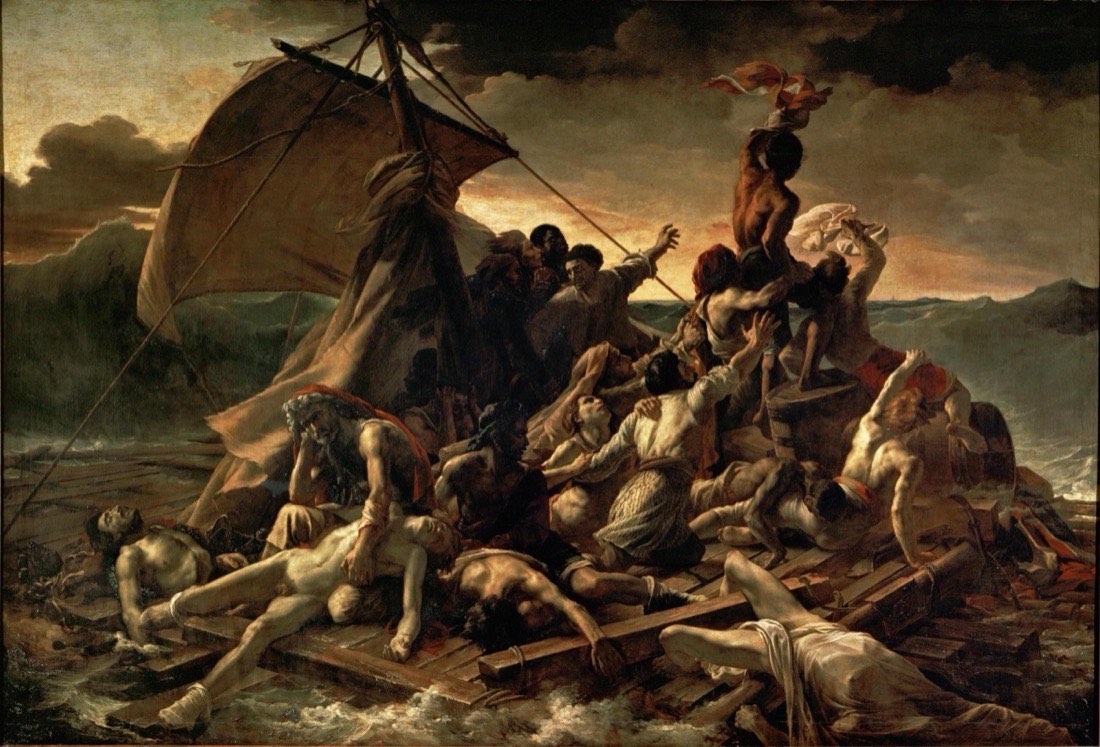
The Raft of the Medusa, by Théodore Géricault (1818-1819), is 4.91 metres high and 7.16 metres wide. To paint it, Géricault shut himself away in a large studio in Neuilly and pushed research to obsession: he studied the faces of the dying and corpses at the Beaujon hospital, had a shipwright who had survived the real wreck build him a model of the raft, and travelled to Le Havre to study the sea and sky.
Look, bottom left of the composition, for a shipwrecked man lying face down, shoulders bare. The model is Eugène Delacroix, who agreed to pose for his elder. Twenty years later, his own painting hangs in this same room.
Liberty Leading the People, by Eugène Delacroix, is officially titled 28 July 1830. Painted between September and December 1830, it was bought by the State in August 1831 for 3,000 francs — then vanished from view for decades. It was not permanently installed at the Louvre until 1875, forty-five years after it was painted. During the Second World War it was evacuated to the Château de Chambord, then to Sourches, and did not return to Paris until June 1945. Its latest restoration was completed in April 2024: the colours you see now are closer to those of 1830 than they have been in a century.
2. Room 702 — Daru: David and Ingres, France in state
The next room, a change of era. Here reign Jacques-Louis David and his pupil Ingres.
The Coronation of Emperor Napoleon I (1807) measures 6.21 by 9.79 metres. David painted close to 190 figures, more than ninety of them identifiable portraits. The detail worth the trip: at the centre of the tribune, Napoleon’s mother attends the ceremony — although she was absent that day. It was the emperor who asked for her to be added. The painting also shows Napoleon about to crown Joséphine himself, rather than the Pope crowning him: David chose the moment that best says who is in command.
In the same room, David’s The Sabine Women and Ingres’s Grande Odalisque. The latter was painted in 1814 for Caroline Murat, Napoleon’s sister and Queen of Naples — an imperial family commission, shown at the Salon only five years later, in 1819. The figure’s elongated back drew plenty of ink: Ingres stretched the anatomy in favour of line, and never sought to justify it.
3. Room 708 — Salon Carré: where Italian painting begins
Leave the 19th century behind and go back five hundred years. The Salon Carré opens the long Italian sequence, starting with a work that still looks like an icon.
The Virgin and Child in Majesty Surrounded by Six Angels, known as the Maestà, by Cimabue (1275-1300), is 4.27 metres high. It is a tempera on gold ground, painted on poplar wood. Look closely at the frame: it carries twenty-six painted medallions — the Redeemer, prophets, the twelve apostles, and saints including Francis of Assisi and Clare.
The panel hung in the church of San Francesco in Pisa until 1810. It entered the Louvre in October 1812, as a spoil of war — like the Wedding Feast at Cana you will see two rooms later. A large part of the museum’s Italian painting arrived by that same route.
In the same room, Botticelli and Fra Filippo Lippi. The contrast with Cimabue, two centuries apart, says on its own what the Renaissance was.
4. Room 710 — Grande Galerie: the Italian Renaissance
Enter the Grande Galerie, a long gallery running the length of the Seine. Room 710 occupies its first bays.
Saint Michael Vanquishing the Devil by Raphael (1518) hangs here. It did not arrive by chance: Francis I commissioned it two years after bringing Leonardo da Vinci to France — the ageing master had settled at Clos Lucé, near Amboise, in the autumn of 1516, with the title of the king’s first painter. Same king, same appetite for Italian art: several paintings in this gallery came from that same impulse.
A few steps further, Andrea Mantegna’s Saint Sebastian, a tempera on canvas. Look at its frame: the porphyry border is painted, a trompe-l’œil.
Its history is worth the detour. The panel left Italy around 1481 as part of a wedding’s luggage — that of Chiara Gonzaga and Gilbert of Bourbon, Count of Montpensier — and spent the following centuries in a small town in the Auvergne, Aigueperse: the Sainte-Chapelle from 1636 to the Revolution, then the collegiate church. It was identified as a Mantegna only in 1854, and the Louvre bought it from the town in 1910. Four and a half centuries in a small Auvergne town.
5. Room 711 — Salle des États: the Mona Lisa, and what faces her
The Salle des États opens off the Grande Galerie. It is the last stop, and the busiest room in the museum.
The Mona Lisa — properly titled Portrait of Lisa Gherardini, wife of Francesco del Giocondo, painted between 1503 and 1519 — is smaller than most visitors expect. You will have little time in front of her, and a queue to respect.
The real tip for this room lies elsewhere: turn around. Behind you is Veronese’s Wedding Feast at Cana (1562-1563), 6.77 by 9.94 metres — the Louvre’s largest painting, and around one hundred and thirty figures. It was painted for the Benedictine refectory of San Giorgio Maggiore in Venice, seized in 1797 by Bonaparte’s troops and brought to the Louvre in 1798. It never went back. Almost every visitor has their back to it while photographing the Mona Lisa.
6. Room 712 — Caravaggio, rejected then coveted
The last room, and the darkest. After the crush around the Mona Lisa, the pace drops: many visitors walk straight through, even though a Caravaggio nearly four metres tall hangs here.
The Death of the Virgin (1601-1606) was commissioned by the jurist Laerzio Cherubini for the church of Santa Maria della Scala, in Rome. The clergy rejected it. What was held against the painter: treating the subject too bluntly — a lifeless Virgin, her body swollen, dishevelled, her feet hanging off the bed. Nothing of the expected Assumption.
The rejected painting then became the object of a chase: the Duke of Mantua bought it as early as 1607, Charles I of England in 1627, then the banker Everhard Jabach in Paris, and finally Louis XIV in 1671. A century after its rejection, it belonged to the King of France.
The room also holds Caravaggio’s portrait of Alof de Wignacourt, Raphael’s The Grand Holy Family, and a Bronzino.
Timing
Total: two hours, room by room:
- Room 700 — The Raft of the Medusa (Géricault) — 10 minutes. Two paintings, but enormous.
- Room 700 — Liberty Leading the People (Delacroix) — 10 minutes.
- Room 702 — The Coronation of Emperor Napoleon I (David) — 8 minutes.
- Room 702 — The Sabine Women (David) — 4 minutes.
- Room 702 — Grande Odalisque (Ingres) — 4 minutes.
- Room 702 — Caroline Murat (Ingres) — 4 minutes.
- Room 708 — Cimabue’s Maestà — 15 minutes.
- Room 710 — Saint Michael Vanquishing the Devil (Raphael) — 7 minutes, walking slowly through the gallery.
- Room 710 — Francis I (Titian) — 6 minutes.
- Room 710 — Saint Sebastian (Mantegna) — 7 minutes.
- Room 711 — The Mona Lisa (Leonardo da Vinci) — 15 minutes, the busiest room.
- Room 711 — Wedding Feast at Cana (Veronese) — 10 minutes.
- Room 712 — The Death of the Virgin (Caravaggio) — 15 minutes.
- Walking between rooms — 5 minutes. The rooms follow one another.
If you have a little more time, the Grande Galerie rewards a walk in both directions — the light changes completely depending on which way you walk.
Sources and verification
Room numbers, dates, dimensions and provenance were checked one by one against the Louvre’s collection database (collections.louvre.fr).
- Louvre Collections: The Raft of the Medusa
- Louvre Collections: Liberty Leading the People
- Louvre Collections: Coronation of Napoleon
- Louvre Collections: Grande Odalisque
- Louvre Collections: Cimabue’s Maestà
- Louvre Collections: Saint Michael Vanquishing the Devil
- Louvre Collections: Mantegna’s Saint Sebastian
- Louvre: the Salle des États and The Wedding Feast at Cana
- Louvre Collections: The Death of the Virgin
Displays and room openings can change. Check the Louvre website on the day of your visit before following a route.
Continue your visit
The Louvre
Listen to the commentary in the gallery
This route gives you a thread to follow. In front of an artwork, CulturAll adds the audio commentary: photograph the work or its label, listen, then ask your questions.