
.jpg)
First, an honest note about crowds
No room at the Louvre can be guaranteed quiet: attendance changes by day, time, groups and room openings. Do not expect empty galleries.
Instead, it suggests stepping away from the direct Mona Lisa route for four painting rooms in the Richelieu and Sully wings. Check the map on the day: these stops are not all next door to one another.
1. Room 826, Richelieu — Poussin and Claude Lorrain
Room 826 on Richelieu level 2 is dedicated to Nicolas Poussin. Start with The Plague at Ashdod (1630–31), also known as The Philistines Struck by Plague.
Its first known buyer, Fabrizio Valguarnera, was implicated in a diamond-theft case. The work later entered Louis XIV’s collection and was at the Louvre before the museum opened in 1793.
In the same room, The Landing of Cleopatra at Tarsus (1642) is signed by Claude Lorrain, the other great French painter settled in seventeenth-century Rome. The two men became friends there — Claude Lorrain joined the Accademia dei Virtuosi al Pantheon in 1643, the papal institution Poussin also frequented — despite very different temperaments: Poussin was a learned painter, trained in art theory and antiquity, while Claude, largely self-taught, relied on an almost instinctive visual sensibility. The scene, drawn from Plutarch's Parallel Lives, shows Cleopatra landing at Tarsus to seduce Mark Antony.
2. Room 825, Richelieu — Poussin, the riddle of Arcadia and a self-portrait
In room 825, still on Richelieu level 2, the detour continues with Poussin. The Shepherds of Arcadia, around 1638, shows shepherds deciphering the inscription “ET IN ARCADIA EGO” carved on a tomb. The phrase is ambiguous: it can be read “even in Arcadia, I [Death] exist” or “I too once lived in Arcadia” — a memento mori or a lament for past happiness. The canvas, 85 by 121 centimetres, belonged to Cardinal Giulio Rospigliosi, the future Pope Clement IX, then to the engineer Henri Avice and the painter-dealer Charles Antoine Hérault; Louis XIV bought it from Hérault in 1685, and after a spell at Versailles it joined the Louvre in 1816.
In the same room, the Self-Portrait of 1650 is one of only two Poussin ever painted; the other, made for Jean Pointel, is in the Gemäldegalerie in Berlin. The Louvre’s was commissioned by his friend Paul Fréart de Chantelou, who had been asking for it since 1647; Poussin promised to send the one that would turn out best. The painter, in grey robes, his face turned frontally, holds a rolled paper tied with a red ribbon in his right hand and wears a pyramid-cut diamond ring on his little finger, a Stoic symbol of strength; in the background, a female figure crowned with a diadem set with an eye embodies Painting. Kept in the Chantelou family by inheritance, the painting entered the Louvre in 1797 by exchange.
3. Room 837, Richelieu — Vermeer
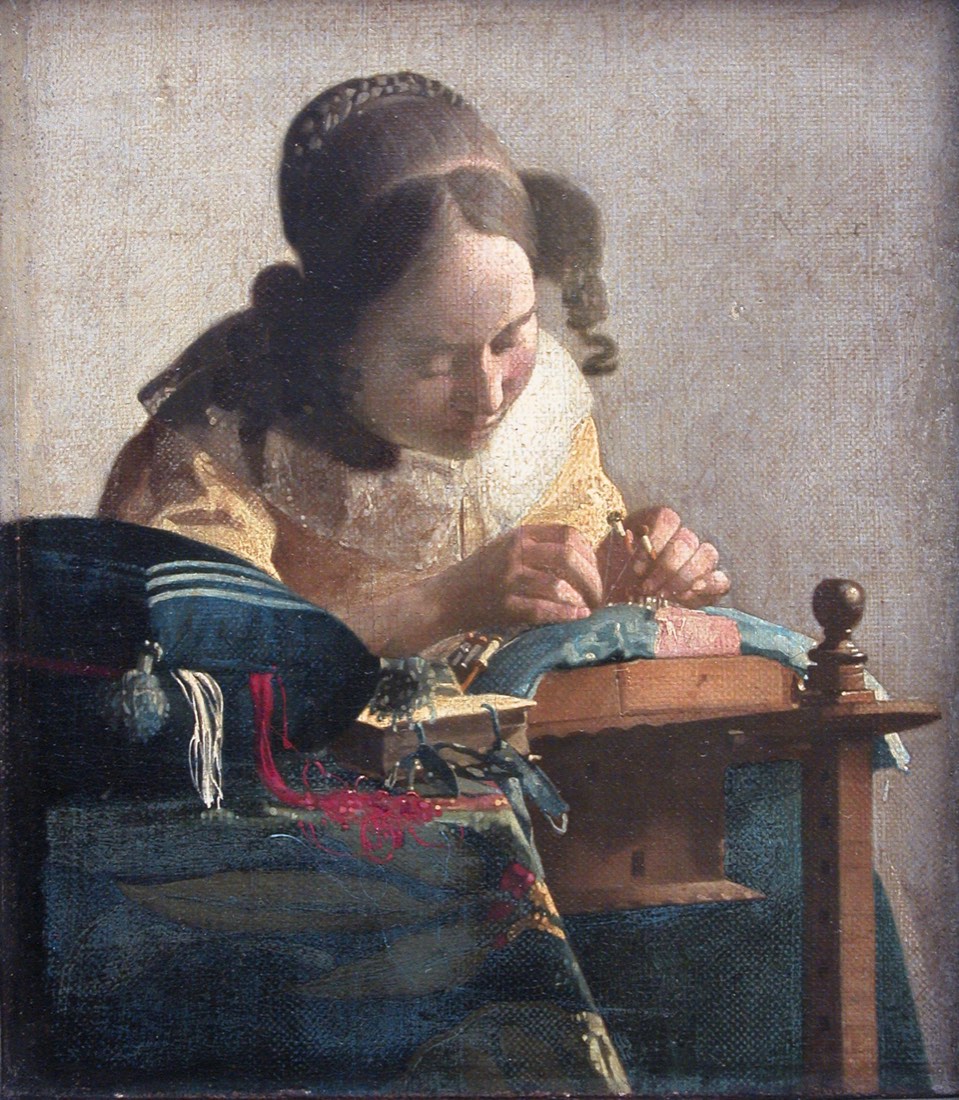
In room 837, find Vermeer’s The Lacemaker, an oil on canvas mounted on wood measuring only 24 × 21 cm. After Denon’s monumental canvases, its scale changes the rhythm of looking.
Resist the quickest reading: nothing points to a professional lacemaker, or to the painter’s wife. The clothing and setting suggest a woman of some standing, absorbed in her needlework. The small book beside her is not identified with certainty as either a Bible or a book of hours, but its size fits either.
A few steps away, The Astronomer (around 1668) is the second of only two Vermeers held in French public collections. Its recent provenance is darker than its quiet scene: the painting belonged to Baron Édouard de Rothschild when his collection was seized in November 1940 by Reichsleiter Rosenberg's task force. Personally coveted by Hitler, it was marked on the back with a small swastika in ink and shipped to Germany in February 1941 in a crate marked with the letter "H." Recovered by the Monuments Men in the Altaussee salt mine in 1945, it was returned to the Rothschild family, who transferred it to the French state in 1983 through a dation in lieu of inheritance tax.
4. Room 912, Sully — La Tour and the Le Nains
Room 912 on Sully level 2 brings together Georges de La Tour and the Le Nain brothers. The Cheat with the Ace of Diamonds dates from 1636–40: gestures and glances expose the carefully staged deception of the richly dressed young dupe.
Make time for Saint Sebastian Tended by Irene, around 1649. Rediscovered in a Norman church in 1945, it was given to the Louvre in 1979 by the Société des Amis du Louvre.
In the same room, Peasant Family (around 1642) illustrates the puzzle surrounding the three Le Nain brothers, Antoine, Louis and Mathieu: their paintings are never signed with anything more than the family name, "Le Nain fecit," with no first name given. For lack of sufficient archives, art historians still cannot settle which brother painted any given canvas made before 1648, the year the two eldest died — a painting given to "Louis" could just as easily turn out to be an "Antoine."
How much time
Nine works spread across four rooms, some at a distance from one another: allow generous time to walk between stops.
- The Plague at Ashdod (Poussin) — 8 minutes.
- The Landing of Cleopatra at Tarsus (Claude Lorrain) — 6 minutes.
- The Shepherds of Arcadia (Poussin) — 7 minutes.
- Self-Portrait (Poussin) — 6 minutes.
- The Lacemaker (Vermeer) — 8 minutes.
- The Astronomer (Vermeer) — 8 minutes.
- The Cheat with the Ace of Diamonds (La Tour) — 8 minutes.
- Saint Sebastian Tended by Irene (La Tour) — 5 minutes.
- Peasant Family (Le Nain) — 6 minutes.
Sources and verification
The locations and stories were checked against official Louvre collection records.
- Louvre Collections: The Plague at Ashdod, room 826
- Louvre Collections: The Landing of Cleopatra at Tarsus
- Louvre Collections: The Shepherds of Arcadia, room 825
- Louvre Collections: Self-Portrait (Poussin), room 825
- Louvre Collections: The Lacemaker, room 837
- Louvre Collections: The Astronomer (Vermeer)
- Louvre Collections: The Cheat with the Ace of Diamonds, room 912
- Louvre Collections: Saint Sebastian Tended by Irene
- Louvre Collections: Peasant Family (Le Nain)
Displays and room openings can change. Check the Louvre website on the day of your visit before following a route.
Continue your visit
The Louvre
Listen to the commentary in the gallery
This route gives you a thread to follow. In front of an artwork, CulturAll adds the audio commentary: photograph the work or its label, listen, then ask your questions.