

A room for two centuries of naval warfare
This gallery traces English naval wars of the sixteenth and seventeenth centuries through the painters who documented them, often Dutch — a direct consequence of the fact that the United Provinces were, for much of this period, England's main enemy or direct rival at sea.
1. 1588: launching fireships against the Invincible Armada
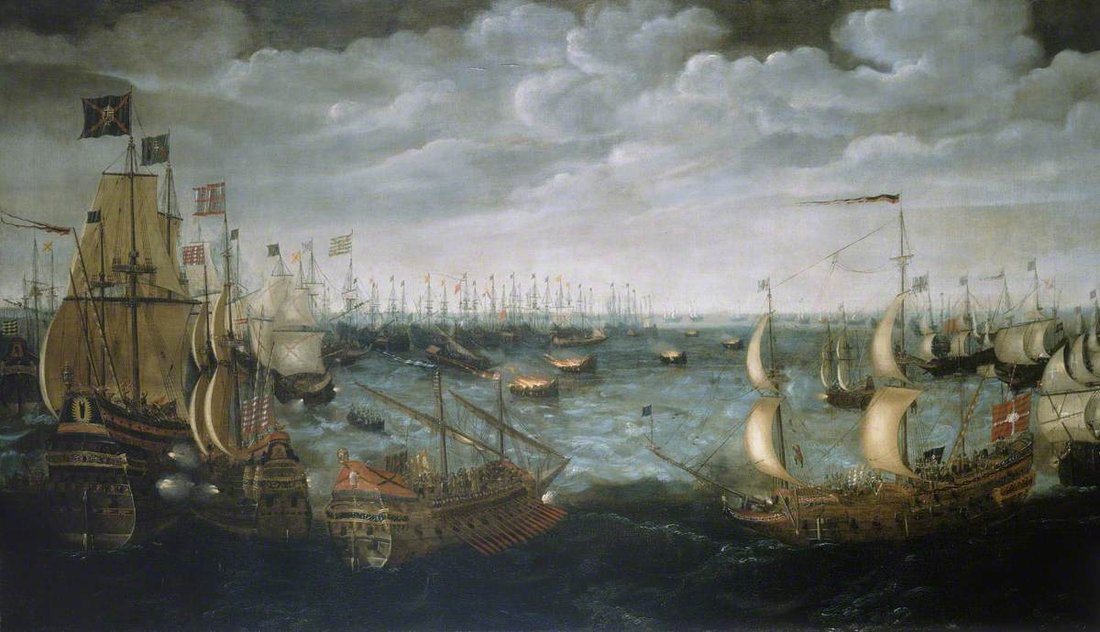
The Launching of the Fireships against the Spanish Armada, 7 August 1588, painted by Aert Anthonisz around 1590, shows one of the decisive episodes of the Spanish attempt to invade England: English ships set alight and let loose, crewless, into the Spanish fleet anchored off Calais, causing panic and scattering the enemy ships. The museum notes that the scene, while inspired by a real event, is an imagined reconstruction rather than a faithful record of that night. The episode marks the beginning of the Armada's rout, largely completed by the storms that later battered the Spanish fleet as it returned north around Scotland and Ireland.
2. 1667: the Medway disaster
Dutch Ships in the Medway, June 1667, painted by Willem Schellinks in the late seventeenth century, documents in panoramic view, from the heights above Sheerness, one of the worst disasters in the history of the Royal Navy: under Admiral Michiel de Ruyter, the Dutch fleet sailed up the Thames and then the Medway, burned Sheerness, and destroyed or captured several major English warships laid up, unmanned, at Chatham. Among the Dutch prizes was the Royal Charles, the flagship that had carried Charles II back from exile in the Netherlands at the Restoration of 1660 — a humiliation made sharper still by the fact that this very ship carried the king's own name.
3. Peter Pett, the builder of the most powerful ship of his age
Peter Pett and the 'Sovereign of the Seas', painted by Peter Lely around 1645-1650, shows the master shipwright standing proudly before the richly decorated stern of the ship he built at Woolwich in 1637 to his father Phineas Pett's designs — considered the most powerful warship of its day. Having become Commissioner at Chatham Dockyard from 1647 to 1667, Pett was in charge of that very dockyard at the moment of the Medway disaster, and would be held responsible for failing to move the ships to safety in time.
4. Van de Velde, the threat of Barbary corsairs
An English Ship in Action with Barbary Corsairs, painted around 1685 by Willem van de Velde the Younger, shows an English two-decker firing from both sides at a burning Barbary vessel, amid sinking galleys. Although no specific engagement has been identified with certainty, the painting illustrates a very real danger to English ships in the 1660s and 70s: attacks by North African corsairs on European maritime trade.
5. Vroom, the father of marine painting and trade at sea
Ships Trading in the East, painted in 1614 by Hendrick Cornelisz Vroom, shows an idealized harbor scene where Dutch, Spanish, and English ships mingle, with elegantly dressed merchants negotiating with sailors unloading goods. Historians see it as a possible allegory of peace during the Twelve Years' Truce (1609-1621) between Spain and the Dutch provinces. Vroom, regarded as the founder of marine painting as a genre in its own right, is known for the meticulous precision of his rigging.
6. De Ruyter, the victor of the Medway in an official portrait
The Portrait of Michiel de Ruyter, painted by Ferdinand Bol in 1667, shows the commander who led the Medway raid a few months earlier, standing full length: dressed in a black coat with gold buttons over a gold-brocaded waistcoat, he holds a commander's baton and wears a pendant of St Michael slaying Satan, marking his admission to the Order of St Michael in 1666. The gold chain and ornate sword belt he wears were presented to him after his victory at the Four Days' Battle, just months before the Medway raid.
On the red-draped table beside him sit navigational instruments and a Blaeu celestial globe; in the background, a seascape depicting his flagship, the Zeven Provinciën, painted separately on an inserted canvas by Willem Van de Velde the Younger — the same painter already present in this room with his fight against Barbary corsairs. The painting thus documents, in official and glorious form, the man who inflicted on the English navy the humiliation told in the neighbouring room.
7. Three legendary corsairs, and another pitched battle against the Dutch
The triple portrait of Thomas Cavendish, Sir Francis Drake and Sir John Hawkins, a British School painting of the seventeenth century probably after a lost original by Daniel Mytens, brings together the three most famous corsair-commanders of the Elizabethan age: Hawkins on the left, in black and gold chains, father of the Elizabethan navy and architect of the fleet that met the Armada; Drake in the centre, his hand resting on a globe in reference to his 1577-80 circumnavigation; Cavendish on the right, in a red doublet, who himself completed the third circumnavigation in history in 1586-88. The painting visually links Drake's 1587 Cadiz raid and the 1588 Armada campaign to the broader Elizabethan drive to explore and raid Spanish territory.
The 'Royal Prince' and Other Vessels at the Four Days Battle, 1-4 June 1666, painted by Abraham Storck around 1670, compresses several episodes of this Second Anglo-Dutch War battle into one dramatic composition: the Dutch flagship De Zeven Provinciën (80 guns) under Lieutenant-Admiral Michiel de Ruyter — already present in this room through his portrait —, the English flagship Royal Prince (85 guns) grounded and captured on the Galloper Shoal, and the Royal Charles (86 guns) under General George Monck. In the foreground, an English ship sinks amid a rescue attempt — a battle distinct from the Medway disaster that would follow a year later, but belonging to the same conflict and the same protagonists.
How much time
A century separates these two battle paintings: look for how the same navy could carry, decades apart, both its greatest victory and its greatest humiliation.
- Background on the room — 6 minutes.
- Fireships against the Armada (Anthonisz) — 8 minutes.
- The Medway disaster (Schellinks) — 8 minutes.
- Peter Pett and the Sovereign of the Seas (Lely) — 6 minutes.
- English Ship against Barbary Corsairs (Van de Velde) — 6 minutes.
- Ships Trading in the East (Vroom) — 6 minutes.
- Portrait of Michiel de Ruyter (Bol) — 6 minutes.
- Cavendish, Drake and Hawkins — 7 minutes.
- The Four Days Battle (Storck) — 7 minutes.
Sources and verification
Checked against the official notices of Royal Museums Greenwich (rmg.co.uk / collections.rmg.co.uk) and cross-checked with Wikipedia EN/FR.
- Royal Museums Greenwich — Dutch Ships in the Medway, June 1667
- Rijksmuseum — The Dutch Raid on the Medway, 1667
- Wikipedia EN — HMS Royal Charles (1660)
- Royal Museums Greenwich — Launch of fireships against the Spanish Armada, 7 August 1588
- Royal Museums Greenwich — Peter Pett and the 'Sovereign of the Seas'
- Royal Museums Greenwich — An English Ship in Action with Barbary Corsairs, circa 1680
- Royal Museums Greenwich — Ships Trading in the East
- Royal Museums Greenwich — Pigott Family Gallery: Tudor and Stuart Seafarers
- Royal Museums Greenwich — Lieutenant-Admiral Michiel de Ruyter (1607-1676)
- Royal Museums Greenwich — Thomas Cavendish, Sir Francis Drake and Sir John Hawkins
- Royal Museums Greenwich — The 'Royal Prince' and Other Vessels at the Four Days Battle, 1-4 June 1666
Displays and room openings can change. Check the Royal Museums Greenwich website on the day of your visit before following a route.
Continue your visit
Royal Museums Greenwich, London
Listen to the commentary in the gallery
This route gives you a thread to follow. In front of an artwork, CulturAll adds the audio commentary: photograph the work or its label, listen, then ask your questions.

