

A room for the history of the Royal Navy
This gallery traces the history of the British navy through its great figures and great moments, from the heroic high point embodied by Nelson to the darker episodes the institution has also chosen to display rather than erase.
1. Shot on his own deck for not "doing his utmost"
The Execution of Admiral Byng, 14 March 1757, shows the death of John Byng, shot by six marines on the deck of the flagship HMS Monarch, in Portsmouth harbour, after being found guilty of not "doing his utmost" to relieve the besieged British garrison at Minorca. According to the Monarch's log, Byng was declared dead at noon and immediately placed in his coffin.
The episode inspired one of Voltaire's most famous lines, in Candide: in England, it is thought good to kill an admiral from time to time, to encourage the others.
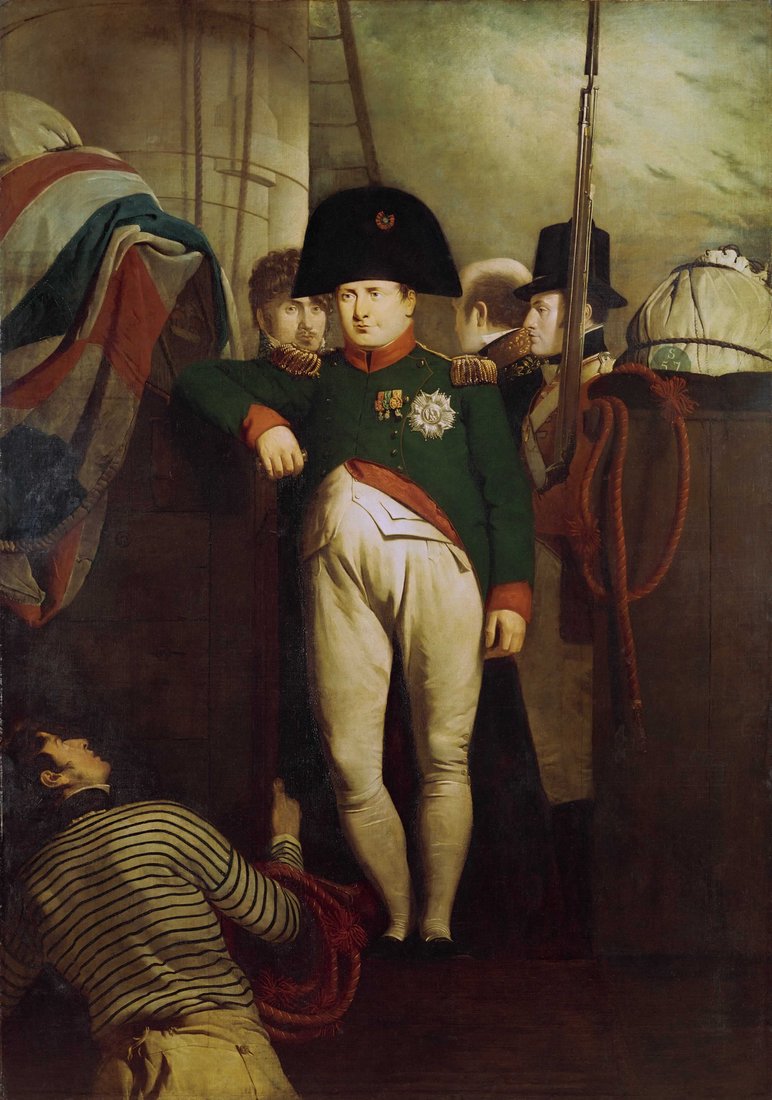
2. A defeated Napoleon, watched by hundreds of sightseers in rowing boats
Napoleon Bonaparte on Board the 'Bellerophon' in Plymouth Sound, painted by Charles Lock Eastlake in 1815, shows the deposed emperor shortly after he boarded on 15 July 1815. For several weeks, while his fate was being decided, Napoleon appeared on deck each evening around 6pm for the benefit of the many boatloads of sightseers who came out into the Sound to catch a glimpse of him — it was by watching these appearances that Eastlake, then a young painter, sketched from life the portrait that would make this painting instantly famous when it was exhibited in London.
How much time
Two images of military defeat, a century and a half apart: one treated as exemplary punishment, the other as public spectacle.
- The Execution of Admiral Byng — 8 minutes.
- Napoleon on Board the Bellerophon — 8 minutes.
Sources and verification
Checked against the official notices of Royal Museums Greenwich (rmg.co.uk / collections.rmg.co.uk) and cross-checked with Wikipedia EN/FR.
- Royal Museums Greenwich — The Execution of Admiral Byng, 14 March 1757
- Wikipedia EN — John Byng
- Royal Museums Greenwich — Napoleon Bonaparte on Board the 'Bellerophon' in Plymouth Sound
- Wikipedia EN — Napoleon on the Bellerophon
Displays and room openings can change. Check the Royal Museums Greenwich website on the day of your visit before following a route.
Continue your visit
Royal Museums Greenwich, London
Listen to the commentary in the gallery
This route gives you a thread to follow. In front of an artwork, CulturAll adds the audio commentary: photograph the work or its label, listen, then ask your questions.