
.jpg)
Flemish Baroque and French Classicism, side by side
This room brings together Flemish Baroque paintings and French Classical canvases of the seventeenth century, including two major works by Peter Paul Rubens and Nicolas Poussin — two competing styles in Catholic Europe of the period, one favoring movement and color, the other composition and balance.
1. The finished painting burned, only the sketch survived
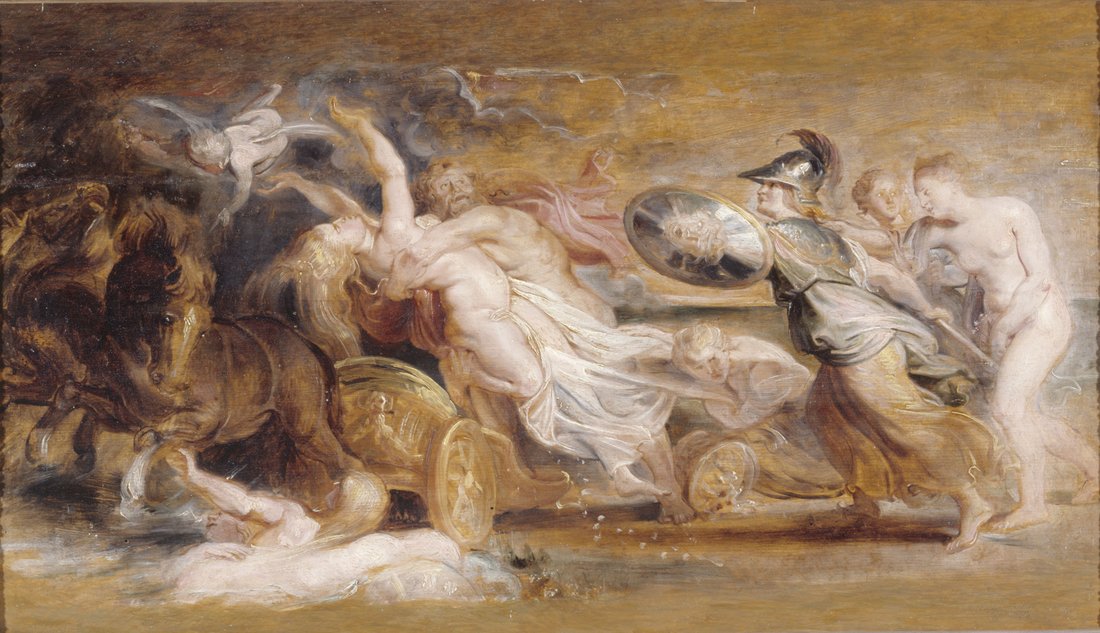
The Abduction of Proserpina, painted by Rubens around 1614-1615, is not the finished painting commissioned from the artist at the time, but his preparatory sketch. The finished version, which entered the collection of the Duke of Marlborough at Blenheim Palace, was destroyed by fire in 1861 — making this sketch, held at the Petit Palais, the only surviving visual record of Rubens's original composition.
2. A Poussin whose authenticity long divided specialists
The Massacre of the Innocents, painted around 1625-1627, had its attribution to Poussin contested for a long time by recognized specialists of the painter, including Anthony Blunt and Jacques Thuillier, who refused to see his hand in it. The painting is now largely accepted as an authentic work by Poussin — a distinct, earlier version from a second, later version of the same subject now held at the Musée Condé in Chantilly, commissioned by a different Roman collector.
How much time
Two paintings, two stories of doubt: one about what the finished work really looked like, the other about who really painted it.
- The Abduction of Proserpina (Rubens) — 8 minutes.
- The Massacre of the Innocents (Poussin) — 8 minutes.
Sources and verification
Checked against the official notices of the Petit Palais (petitpalais.paris.fr / parismuseescollections.paris.fr) and cross-checked with Wikipedia EN/FR.
- Petit Palais — Pierre Paul Rubens, L'Enlèvement de Proserpine, entre 1614 et 1615
- Paris Musées Collections — L'Enlèvement de Proserpine
- Petit Palais — Nicolas Poussin, Le Massacre des Innocents, vers 1626-1627
- Wikipédia FR — Le Massacre des Innocents (Poussin)
Displays and room openings can change. Check the Petit Palais website on the day of your visit before following a route.
Continue your visit
Petit Palais, Paris
Listen to the commentary in the gallery
This route gives you a thread to follow. In front of an artwork, CulturAll adds the audio commentary: photograph the work or its label, listen, then ask your questions.