

Impressionism and its aftermath, room by room
This room brings together canvases by Claude Monet, Alfred Sisley, Camille Pissarro and Paul Cézanne painted between the 1870s and the turn of the century — a group that shows Impressionism both at its high point and in the tensions that ran through the movement, notably over the question of the official Salon.
1. A two-canvas strategy
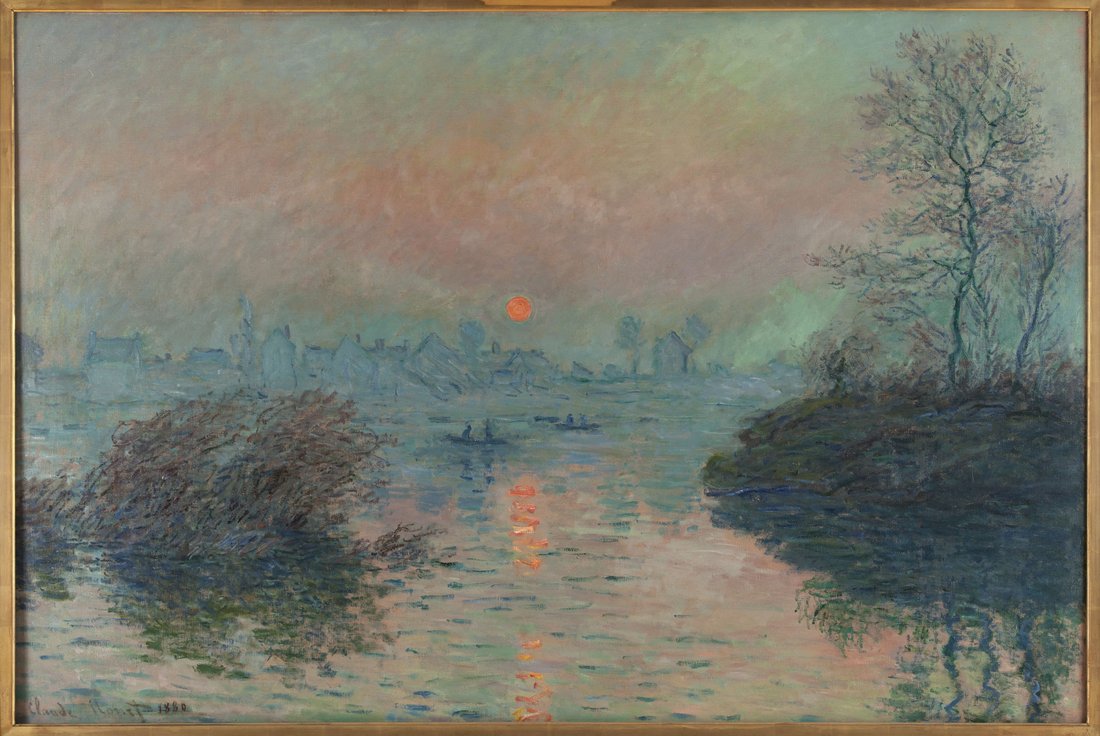
In 1880, after several years exhibiting only at the independent Impressionist shows, Monet, short of money, decided to try his luck again at the official Salon at the Louvre, which he had deserted after a rejection in 1870. He deliberately prepared two paintings: a view of Lavacourt he judged "wiser, more bourgeois" in his own words, meant to please the jury, and a second, more experimental canvas he knew was a risk. He wrote to a friend that he was playing "a big game," while already being called a coward by his former Impressionist companions over this attempt to return to the Salon.
2. The rejected painting, now at the Petit Palais
Sunset on the Seine at Lavacourt, Winter Effect, the more experimental of the two canvases, showing the breaking ice on the Seine, was rejected by the 1880 Salon jury — it was the more conventional version that was accepted and exhibited. The painting held at the Petit Palais therefore shows Monet's more personal vision from this period, the very one the official Salon judged too bold.
3. Sisley, three faces of the same landscape art
The Woodcutters, painted in 1876 and shown at the third Impressionist exhibition in 1877, shows two workers seen from behind sawing a tree trunk set up on scaffolding in a village street — one of Sisley's rare paintings devoted to labor rather than landscape alone.
The Church at Moret, Evening, painted in 1894, belongs to a series Sisley devoted to this same church in the village where he had settled, painted at different times of day and in different seasons — a serial approach contemporary with the one Monet was applying to Rouen Cathedral. The Tugboat, the Loing at Saint-Mammès, painted around 1883, shows a row of poplars and strollers watching boats on the river, gray smoke rising from a tugboat's stack — one of many landscapes Sisley painted after settling near the Fontainebleau forest in 1880.
4. Pissarro, an intimate portrait of his wife
Julie Pissarro in the Garden, painted around 1874, shows the painter's wife seated in a garden, seen from three-quarters, a sewing basket resting on her arm — a domestic family portrait, far from the landscapes Pissarro is best known for, painted in the same year as the first Impressionist exhibition he took part in.
5. Cézanne, the bathers who occupied him his whole life
Three Bathers, painted between 1879 and 1882, shows a pyramidal composition of three bathers in a wooded space crossed by a broad ray of light reflected in the water — one of the more than two hundred paintings, watercolors, and drawings Cézanne devoted to the theme of bathers throughout his career, from the 1860s until his death in 1906.
6. Boudin and Jongkind, two forerunners of Impressionism
Squall off Frascati, Le Havre, painted by Eugène Boudin in 1896, shows a stormy day: waves break on a beach lined with bathing huts, fishermen haul their boats out of the water while a tricolour flag snaps on a mast, and the beach ends at a jetty topped by a lighthouse — the low horizon leaving most of the composition to the stormy sky. The painting was bought by the City of Paris at the 1897 Salon of the Société nationale des Beaux-Arts.
Notre-Dame Seen from the Quai de la Tournelle, painted by Johan Barthold Jongkind in 1852, shows an urban view of Notre-Dame from the Quai de la Tournelle, with the Seine, a cart, and workmen paving the street. Jongkind, a Dutch painter based in Paris from 1846, is widely credited as the most direct forerunner of the outdoor light effects Monet and Boudin pursued — presumably why his painting hangs alongside theirs in this room.
How much time
Look for the date 1880 on the Monet's label: it's the year Monet gambled, and lost, his bet with the official Salon.
- Background on the room — 6 minutes.
- Lavacourt, Winter Effect (Monet) — 10 minutes.
- The Woodcutters (Sisley) — 6 minutes.
- The Church at Moret, Evening (Sisley) — 6 minutes.
- The Tugboat, the Loing at Saint-Mammès (Sisley) — 5 minutes.
- Julie Pissarro in the Garden (Pissarro) — 6 minutes.
- Three Bathers (Cézanne) — 7 minutes.
- Squall off Frascati, Le Havre (Boudin) — 7 minutes.
- Notre-Dame Seen from the Quai de la Tournelle (Jongkind) — 7 minutes.
Sources and verification
Checked against the official notices of the Petit Palais (petitpalais.paris.fr / parismuseescollections.paris.fr) and cross-checked with Wikipedia EN/FR.
- Petit Palais — Soleil couchant sur la Seine à Lavacourt, effet d'hiver
- Wikipédia FR — Soleil couchant sur la Seine, effet d'hiver
- DailyArt Magazine — Masterpiece Story: Sunset on the Seine at Lavacourt, Winter Effect
- Paris Musées Collections — Soleil couchant sur la Seine à Lavacourt, effet d'hiver
- Paris Musées — Les scieurs de long, Sisley
- Paris Musées — L'Eglise de Moret (le soir), Sisley
- Paris Musées — Le remorqueur, le Loing à Saint-Mammès, Sisley
- Paris Musées — Julie Pissarro au jardin
- Paris Musées — Trois baigneuses, Cézanne
- Paris Musées — Coup de vent devant Frascati, Le Havre, Boudin
- Paris Musées — Notre-Dame vue du quai de la Tournelle, Jongkind
Displays and room openings can change. Check the Petit Palais website on the day of your visit before following a route.
Continue your visit
Petit Palais, Paris
Listen to the commentary in the gallery
This route gives you a thread to follow. In front of an artwork, CulturAll adds the audio commentary: photograph the work or its label, listen, then ask your questions.

