

First, an honest note
No room at the Musée d’Orsay is guaranteed quiet: footfall depends on the day, the time and the tour groups. But the median level, between the Impressionist rooms above and the sculpture on the ground floor, is markedly less busy — many visitors head straight for the exit without passing through it.
"Nabi" means "prophet" in Hebrew: a group of young painters, including Bonnard, Vuillard and Maurice Denis, chose this name around 1888 to assert their wish to renew painting. The founding legend holds that Paul Sérusier painted a small landscape at Pont-Aven, in October 1888, under Gauguin’s direction — a panel measuring 27 by 21 centimetres that the group nicknamed its "Talisman" and treated almost like a relic.
1. Room 68 — Toulouse-Lautrec and the Moulin Rouge
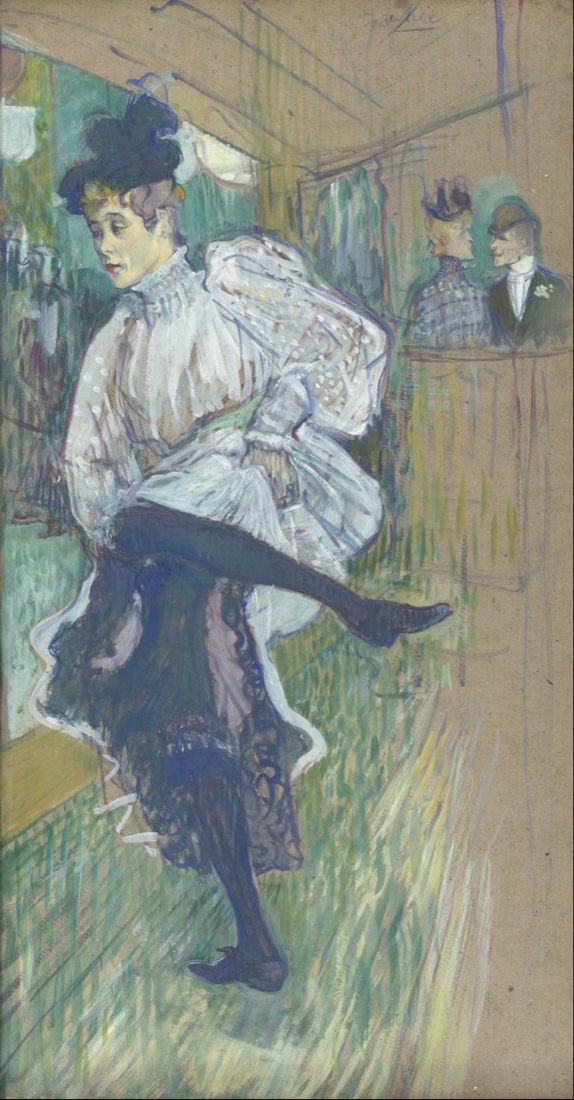
Jane Avril Dancing (around 1892) is painted in peinture à l’essence — oil thinned with turpentine, which lets the line flow freely. Toulouse-Lautrec captures the movement of a dancer who performed at the Moulin Rouge, then at Les Décadents, at Le Divan Japonais, before triumphing at the Folies-Bergère.
The painting entered the collection in 1937, through the bequest of Antonin Personnaz, one of the museum’s great donors.
2. Room 70 — Vallotton, colour laid flat
The Ball by Félix Vallotton (1899) shows a public garden seen from above: a running child forms a bright patch of light, its shadow running ahead of it, against an ochre ground and the deep shade of the trees. Vallotton, a Swiss painter, joined the Nabis’ circle in 1891.
The contrast with Toulouse-Lautrec is stark: the same generation, but colour laid flat, almost like a poster, rather than a line that captures a gesture.
3. Room 71 — Vuillard at the Natansons
Misia Seated in an Armchair, called "Nonchaloir" shows Misia Natanson, the Nabis’ muse and wife of Thadée Natanson, editor-in-chief of the Revue blanche, the avant-garde journal that supported these painters. From 1893, Vuillard was an almost daily visitor to the couple’s apartment on rue Saint-Florentin.
The whole room belongs to that same world: bourgeois interiors painted from the inside, by someone who was invited in, rather than by a passing visitor.
4. Room 72 — Bonnard’s four panels
Women in a Garden forms a set of four panels painted by Bonnard in 1891, originally conceived as a folding screen: Woman in a Dress with White Dots, Woman Seated with a Cat, Woman in a Checked Dress and Woman in a Cape. Shown at the Salon des Indépendants and then at the Galerie Le Barc de Boutteville as early as 1891-1892, they did not enter the public collections until 1984, accepted by the French State in lieu of inheritance tax.
Take the time to look at them as a single work in four movements, rather than four separate paintings: that is how they were conceived.
How long it takes
As a guide, work by work:
- Jane Avril Dancing (Toulouse-Lautrec, room 68) — 15 minutes.
- The Ball (Vallotton, room 70) — 15 minutes.
- Misia Seated in an Armchair, called "Nonchaloir" (Vuillard, room 71) — 18 minutes.
- Woman in a Dress with White Dots (Bonnard, room 72) — 6 minutes.
- Woman Seated with a Cat (Bonnard, room 72) — 6 minutes.
- Woman in a Checked Dress (Bonnard, room 72) — 6 minutes.
- Woman in a Cape (Bonnard, room 72) — 5 minutes.
- Walking between rooms — 10 minutes.
Sources and verification
The rooms, dates and provenance below were checked against the Musée d’Orsay’s website.
- Musée d’Orsay: The Talisman, Landscape at the Bois d’Amour
- Musée d’Orsay: Jane Avril Dancing, room 68
- Musée d’Orsay: The Ball, room 70
- Musée d’Orsay: Misia Seated in an Armchair, called "Nonchaloir", room 71
- Musée d’Orsay: Women in a Garden, room 72
- Musée d’Orsay: Women in a Garden, woman in a dress with white dots
- Musée d’Orsay: Women in a Garden, woman seated with a cat
- Musée d’Orsay: Women in a Garden, woman in a checked dress
- Musée d’Orsay: Women in a Garden, woman in a cape
Displays and room openings can change. Check the Musée d’Orsay website on the day of your visit before following a route.
Continue your visit
The Musée d’Orsay
Listen to the commentary in the gallery
This route gives you a thread to follow. In front of an artwork, CulturAll adds the audio commentary: photograph the work or its label, listen, then ask your questions.