

The principle: stay on the upper level
The Gare d’Orsay was inaugurated on 14 July 1900, for the Universal Exposition, to plans by the architect Victor Laloux. Closed to rail traffic in 1939, it became a museum inaugurated by François Mitterrand on 1 December 1986. The upper level, under the glass roof, occupies the site of the old platforms.
This route stays there from start to finish: five rooms in sequence, devoted to painting. The ground-floor sculpture and the Nabis of the median level belong to other routes.
1. Room 29 — Manet opens the museum
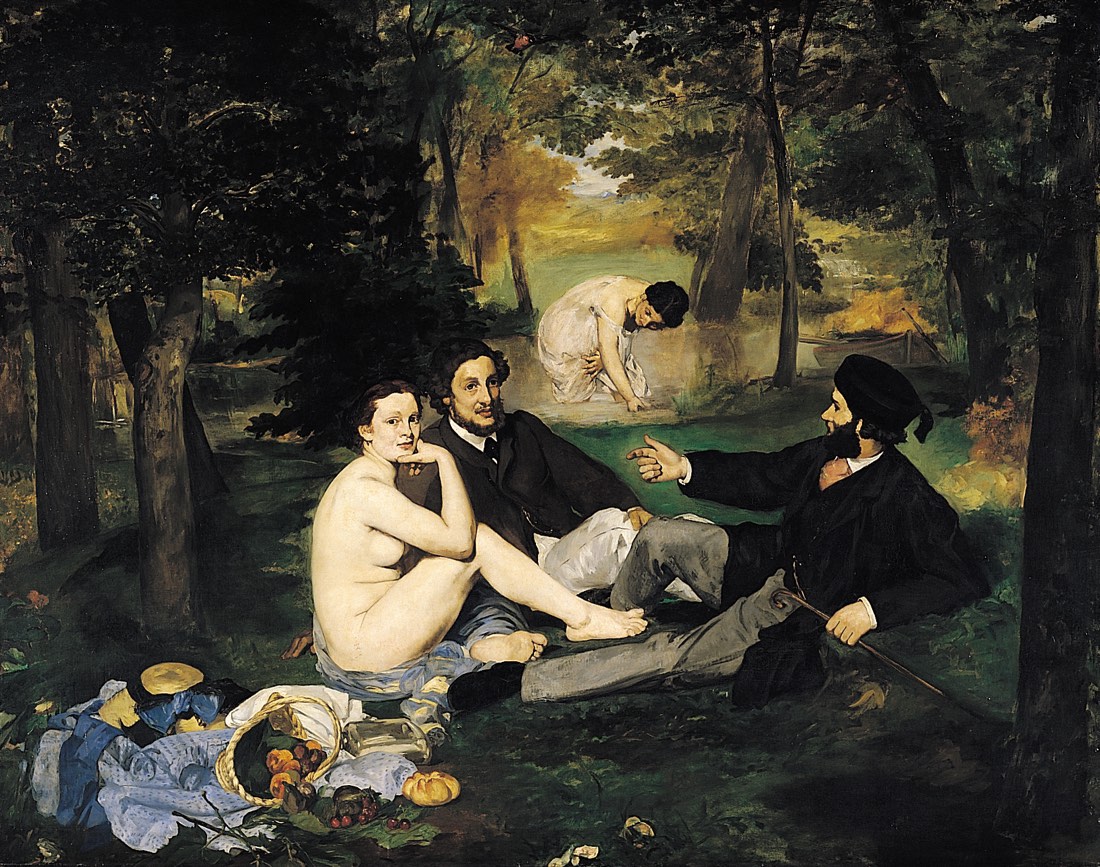
Luncheon on the Grass (1863) was rejected by the jury of the 1863 Salon. Napoleon III then authorised a Salon des Refusés: Manet showed his painting there under the title The Bath, where it became the main attraction, between laughter and scandal.
What shocked viewers: a nude woman seated near two clothed men, with no mythological or allegorical pretext to justify it — and resolutely contemporary clothing. The Musée d’Orsay now presents this painting as one possible starting point of modern art.
2. Room 31 — Caillebotte and Degas, the city and the dance
The Floor Scrapers (1875) was also rejected by the Salon — this time for a subject deemed too crude: workers, bare-chested, labouring in a Parisian apartment. Caillebotte then joined the Impressionists and showed the painting at their second exhibition, in 1876. His family donated it in 1894 to the Musée du Luxembourg, before it passed through the Louvre in 1929, then the Jeu de Paume in 1947, and finally the Musée d’Orsay in 1986.
In the same room, Degas’s Blue Dancers (1884-1885), a pastel. Degas worked in layers, fixing each one before adding the next — a technique that gives the tutus their matter, at once dense and diaphanous.
3. Room 32 — three women painters, in the same room
The Cradle by Berthe Morisot (1872) shows her sister Edma watching over her sleeping daughter Blanche — the first motherhood scene in Morisot’s work, a subject that would become one of her favourites. The painting was shown at the very first Impressionist exhibition, in April 1874, at the photographer Nadar’s studio: Morisot was then the only woman in the group.
Room 32 also brings together Young Girl in the Garden by Mary Cassatt and two canvases by Marie Bracquemond, including The Lady in White. This room alone gathers more women Impressionist painters than the rest of the route.
4. Room 34 — Monet paints the same cathedral thirty times
Between 1892 and 1894, Claude Monet painted around thirty views of Rouen Cathedral. He set up on the floor above a lingerie and fashion shop, directly across from the portal, and worked on several canvases at once within the same day, switching support as the light changed.
The Musée d’Orsay holds several of them, including The Portal, grey weather, shown in this room. Seen side by side, the series documents less the cathedral itself than the light sliding over it, hour by hour.
5. Room 36 — the Van Gogh room
This room is devoted entirely to Van Gogh. Starry Night, painted in Arles in September 1888, shows the Rhône under a sky he described to his sister in a letter: "it often seems to me that night is even more richly coloured than day." Do not confuse it with the other Starry Night, painted the following year from the window of the asylum at Saint-Rémy-de-Provence and held at MoMA in New York: these are two different paintings.
The Portrait of Doctor Paul Gachet dates from Auvers-sur-Oise, in 1890, where Van Gogh settled on his brother Théo’s advice. Gachet, a homeopathic physician and engraver, was a friend of Manet, Monet, Renoir and Cézanne. Van Gogh painted him in a melancholic pose; only a foxglove flower, on the table, brings a note of hope to this cold-toned portrait.
How long it takes
As a guide, room by room — allow around 1h45 in total, excluding any queue:
- Room 29 — Luncheon on the Grass (Manet) — 20 minutes.
- Room 31 — The Floor Scrapers (Caillebotte) — 10 minutes.
- Room 31 — Blue Dancers (Degas) — 10 minutes.
- Room 32 — The Cradle (Morisot) — 10 minutes, in the densest room on the route.
- Room 32 — Young Girl in the Garden (Cassatt) — 10 minutes.
- Room 34 — Rouen Cathedral, the Portal, grey weather (Monet) — 15 minutes.
- Room 36 — Starry Night (Van Gogh) — 10 minutes, in the Van Gogh room.
- Room 36 — Portrait of Doctor Paul Gachet (Van Gogh) — 10 minutes.
- Walking between rooms — 10 minutes. The rooms follow one another.
Sources and verification
The rooms, dates and provenance below were checked against the Musée d’Orsay’s website.
- Musée d’Orsay: Luncheon on the Grass, room 29
- Musée d’Orsay: The Floor Scrapers, room 31
- Musée d’Orsay: Blue Dancers, room 31
- Musée d’Orsay: The Cradle, room 32
- Musée d’Orsay: Young Girl in the Garden, room 32
- Musée d’Orsay: Rouen Cathedral, The Portal, grey weather, room 34
- Musée d’Orsay: Starry Night, room 36
- Musée d’Orsay: Portrait of Doctor Paul Gachet, room 36
Displays and room openings can change. Check the Musée d’Orsay website on the day of your visit before following a route.
Continue your visit
The Musée d’Orsay
Listen to the commentary in the gallery
This route gives you a thread to follow. In front of an artwork, CulturAll adds the audio commentary: photograph the work or its label, listen, then ask your questions.