

The principle: the break before the breakthrough
This route stays on the ground floor, across four rooms in sequence. It comes before the Impressionist route on the upper level — it tells the conditions that made it possible, rather than the paintings themselves.
The last room of this route and the first room of the other share the same model, Victorine Meurent, painted by Manet two years apart. The two routes can be read in order, as a single story across eight rooms.
1. Room 1 — Ingres against Delacroix
The first room places face to face two painters who did not like each other: Ingres, a defender of drawing and the classical line, and Delacroix, a painter of colour and Romantic movement. The Musée d’Orsay treats this as a deliberate dialogue, not an accident of hanging.
Ingres shows Venus at Paphos here; Delacroix, hunting and horse scenes — notably Arab Horses Fighting in a Stable. Two opposite ways of painting movement, in the same room.
2. Room 4 — Millet paints peasants
The Gleaners (1857) is the outcome of ten years of research by Millet on this subject: women allowed to gather, before nightfall, the ears of grain left behind after the harvest. He paints three of them, backs bent, in the foreground.
The Angelus (1857-1859) shows a peasant couple interrupting their work at the evening bell. Millet later explained that the idea came from a childhood memory — his grandmother made them say this prayer for the dead —, not from a religious project: he was not a churchgoer. The painting went on to have an eventful history: an attempted purchase by the Louvre triggered a wave of patriotic fervour in 1889, Salvador Dalí made it an obsession, and a disturbed man slashed it with a knife in 1932.
3. Room 7 — Courbet, ordinary life at a very large scale
A Burial at Ornans (1849-1850) measures 3.15 by 6.68 metres: a format until then reserved for history or mythology, used to paint an anonymous village funeral, with life-size villagers and no idealisation.
The Painter’s Studio, 3.61 by 5.98 metres, was rejected by the jury of the 1855 Universal Exposition. Courbet then built, at his own expense, right next to it, his own "Pavilion of Realism" to show it outside the official circuit — a gesture of independence the Impressionists would echo, differently, twenty years later.
4. Room 14 — Manet and the Olympia scandal
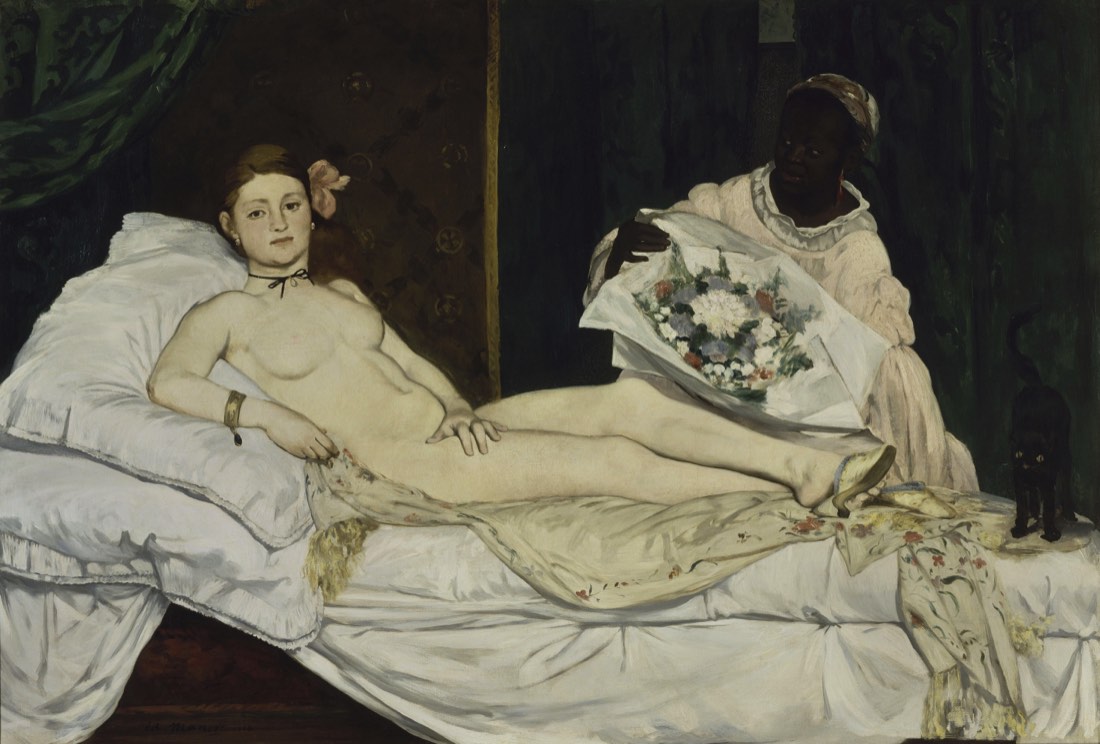
Olympia (1865) reworks a classical subject, the reclining female nude, with precise references to Titian and Goya. But Manet paints a very real courtesan, with a direct, calculating gaze, rather than a goddess. A critic of the time summed up the reception: "What is this yellow-bellied odalisque?"
The model, Victorine Meurent, is also the one in Luncheon on the Grass, painted two years earlier and shown on the upper level, in room 29 of the Impressionist route.
How long it takes
As a guide, work by work:
- Venus at Paphos (Ingres, room 1) — 7 minutes.
- Arab Horses Fighting in a Stable (Delacroix, room 1) — 8 minutes.
- The Gleaners (Millet, room 4) — 10 minutes.
- The Angelus (Millet, room 4) — 10 minutes.
- A Burial at Ornans (Courbet, room 7) — 10 minutes.
- The Painter's Studio (Courbet, room 7) — 10 minutes.
- Olympia (Manet, room 14) — 20 minutes.
- Walking between rooms — 10 minutes.
Sources and verification
The rooms, dates and provenance below were checked against the Musée d’Orsay’s website.
- Musée d’Orsay: Venus at Paphos, room 1
- Musée d’Orsay: Arab Horses Fighting in a Stable, room 1
- Musée d’Orsay: The Gleaners, room 4
- Musée d’Orsay: The Angelus, room 4
- Musée d’Orsay: A Burial at Ornans, room 7
- Musée d’Orsay: The Painter’s Studio, room 7
- Musée d’Orsay: Olympia, room 14
Displays and room openings can change. Check the Musée d’Orsay website on the day of your visit before following a route.
Continue your visit
The Musée d’Orsay
Listen to the commentary in the gallery
This route gives you a thread to follow. In front of an artwork, CulturAll adds the audio commentary: photograph the work or its label, listen, then ask your questions.