

A room for late Impressionism
This room brings together canvases Claude Monet painted in the 1880s alongside Georges Seurat's masterpiece and a canvas by Paul Signac — a way of showing how a generation of painters younger than Monet tried to push the Impressionists' optical experiments further, in an almost scientific direction.
1. Dozens of studies for a single Sunday
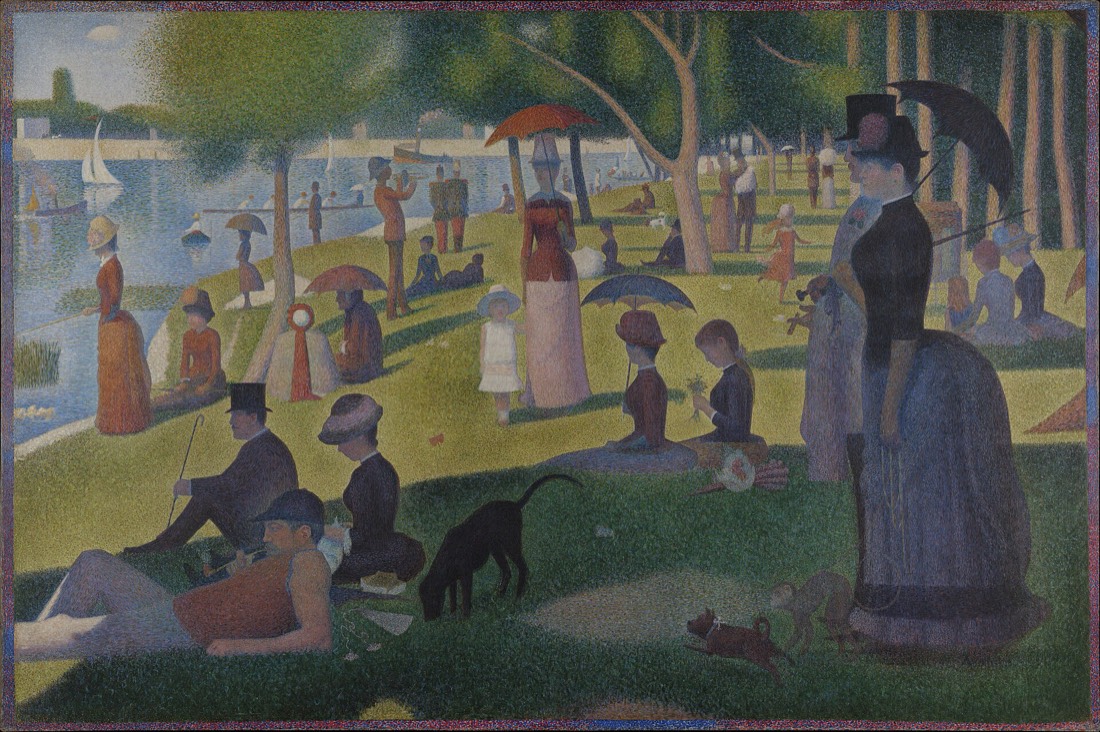
A Sunday on La Grande Jatte — 1884, painted by Georges Seurat between 1884 and 1886, shows Parisians of every social class enjoying an afternoon by the Seine, on an island northwest of Paris. Seurat prepared this monumental canvas with an unusual number of studies: conté crayon drawings and oil sketches on panel, dozens of which are now scattered across museums around the world.
The painting entered the Art Institute of Chicago's collection in 1926, a gift from Bertha Palmer and her family, one of the great American collectors of Impressionism of her time.
2. Pointillism did not yet exist in the sketch
The oil sketch hung right next to the finished painting shows a still-loose brushwork made of diagonal, crisscrossing hatching strokes — Seurat had not yet reduced his touch to the uniform dot that would give pointillism its name. Comparing the two canvases, the sketch and the final version, is the best way to see the technical transformation Seurat carried out between the quick study and the finished work, where every stroke of pure color is meant to blend optically in the eye of a viewer standing a few steps back.
3. A study for Seurat's other great painting
Final Study for "Bathers at Asnières," painted in 1883, prepares Seurat's other monumental masterpiece, now held at the National Gallery in London: men and boys bathing by the Seine at Asnières, a working-class suburb directly facing the leisure park of La Grande Jatte depicted across the river. Unlike classic Impressionist scenes, Seurat freezes gestures and poses here rather than capturing a fleeting instant — while still keeping Impressionism's luminous palette and airy brushwork.
The painting first belonged to the collector Robert Caze, who received it from Seurat himself, before passing through several private collections and the New York gallery Wildenstein; it joined the Art Institute in 1962, a gift from David M. and Adele R. Levy. Seen alongside the studies for La Grande Jatte, this small oil on panel shows Seurat working on both banks of the same river at the same moment in his life.
4. Monet, the Mediterranean and Normandy
Cliff Walk at Pourville, painted in 1882, shows two young women atop a cliff overlooking the English Channel, in summer light and a brisk wind that contrasts with the fishing boats visible on the horizon — one of roughly a hundred paintings Monet made along the coast of Normandy that year, between Pourville and Dieppe.
Bordighera, painted in 1884, documents an entirely different trip: taken with this Italian Riviera village during a visit with Renoir in late 1883, Monet returned in early 1884 for a three-week working stay that stretched into nearly three months. Painted from a hilltop vantage point, the composition lets the sea show only through the interlaced trunks of pine trees; Monet wrote to the sculptor Rodin that he felt he was "fencing, wrestling, with the sun."
Poppy Field (Giverny), painted in 1890-91, belongs to a series of four nearly identically scaled canvases Monet began in July 1890 to depict the poppy fields near his home in Giverny — a direct precursor to his later Stacks of Wheat, begun the same summer. The surface here has a homogeneous, almost woven touch that stands apart from the freer brushwork of his early-1880s Normandy landscapes.
Rocks at Port-Goulphar, Belle-Île, painted in 1886, documents a stay Monet had planned for two weeks on this Breton island in the autumn of 1886, which stretched into more than two months; he described the place as "lugubrious," "terrifying," and yet "very beautiful." The painting shows the dramatic rock frieze of Port-Goulphar, one of the few views Monet devoted to this exact formation.
5. Signac, the other pointillist
Les Andelys, Côte d'Aval, painted by Paul Signac in 1886, shows a village on the Seine near Giverny, treated with the same pointillist technique as Seurat, whose principal companion Signac was in inventing this pictorial language. Triangular patches of blue suggest the curves of the river, while trapezoidal shapes in the background structure the cultivated hillside — a geometrisation of landscape typical of the more systematic approach Signac would develop throughout his career.
Seeing this canvas a few steps from La Grande Jatte makes it possible to grasp that, by 1886 — the very year Seurat exhibited his finished canvas for the first time — pointillism had already become a language shared by several painters, not the isolated invention of a single artist.
How much time
Step back several paces in front of the large canvas, then move in close: it is the only way to watch the optical mechanics of pointillism assemble and fall apart. Allow close to three quarters of an hour for the room's six works.
- Background on the room — 6 minutes.
- A Sunday on La Grande Jatte — 1884 — 12 minutes.
- Its preparatory oil sketch — 6 minutes.
- Final Study for Bathers at Asnières — 6 minutes.
- Cliff Walk at Pourville (Monet) — 6 minutes.
- Bordighera (Monet) — 6 minutes.
- Les Andelys, Côte d'Aval (Signac) — 6 minutes.
- Poppy Field, Giverny (Monet) — 6 minutes.
- Rocks at Port-Goulphar, Belle-Île (Monet) — 6 minutes.
Sources and verification
Checked against the official notices of the Art Institute of Chicago (artic.edu) and cross-checked with Wikipedia EN/FR.
- Art Institute of Chicago — A Sunday on La Grande Jatte — 1884
- Art Institute of Chicago — Oil Sketch for "A Sunday on La Grande Jatte — 1884"
- Art Institute of Chicago — Seurat and "La Grande Jatte"
- Britannica — A Sunday on La Grande Jatte—1884
- Art Institute of Chicago — Final Study for "Bathers at Asnières" (Gallery 240)
- Art Institute of Chicago — Cliff Walk at Pourville (Gallery 240)
- Art Institute of Chicago — Bordighera (Gallery 240)
- Art Institute of Chicago — Les Andelys, Côte d'Aval, Paul Signac (Gallery 240)
- Art Institute of Chicago — Poppy Field (Giverny), Claude Monet (Gallery 240)
- Art Institute of Chicago — Rocks at Port-Goulphar, Belle-Île, Claude Monet (Gallery 240)
Displays and room openings can change. Check the Art Institute of Chicago website on the day of your visit before following a route.
Continue your visit
Art Institute of Chicago
Listen to the commentary in the gallery
This route gives you a thread to follow. In front of an artwork, CulturAll adds the audio commentary: photograph the work or its label, listen, then ask your questions.

