
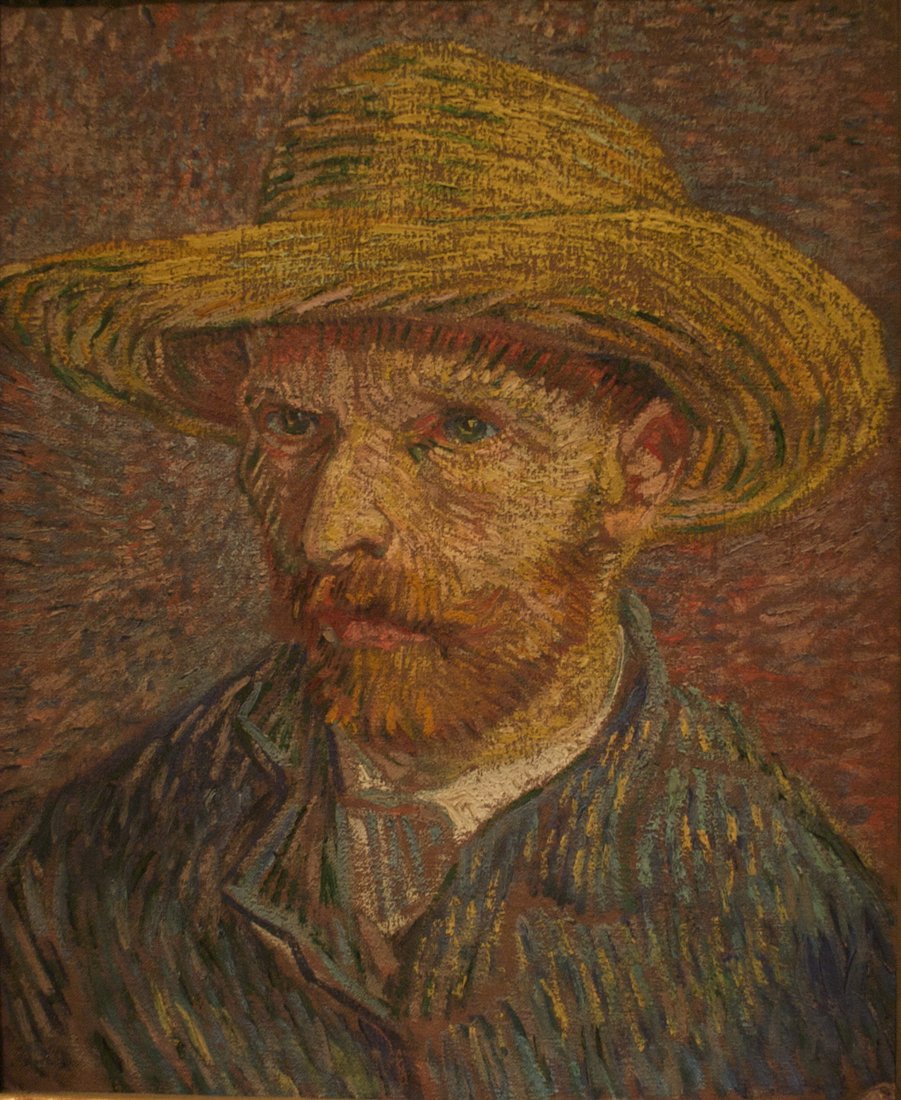

Three pillars of Post-Impressionism in a single room
This gallery brings together Vincent van Gogh, Paul Gauguin and Georges Seurat — three painters who, in the late 1880s, each tried in his own way to move beyond Impressionism: through pure color and emotionally charged brushwork in Van Gogh, through Symbolist flat color and Tahitian tones in Gauguin, through the scientific method of pointillism in Seurat.
1. A self-portrait painted over an already-used canvas
Self-Portrait with a Straw Hat, painted by Van Gogh in 1887 during his time in Paris, is painted on the front of a canvas whose reverse carries an earlier picture, The Potato Peeler, made in 1885 during his Dutch period in Nuenen. Short of money, Van Gogh reused this already-painted canvas rather than buying a new one — a move found on several of the roughly twenty self-portraits painted during his two years in Paris, where he used his own face as a model for lack of money to pay anyone else.
In the same room, the Sunflowers painted in Paris date from the same period, before Van Gogh developed the more famous version of this motif the following year, in Arles.
2. The final study for a painting on view elsewhere
Georges Seurat painted dozens of studies before completing A Sunday on La Grande Jatte, now held at the Art Institute of Chicago. The final study for La Grande Jatte, on view in this room at the Metropolitan Museum, is the last preparatory step before the finished version — a rare chance to see Seurat's process without having to compare two different museums.
Nearby, Gauguin's Tahitian canvases, such as Ia Orana Maria, show the painter after his final departure from Europe in 1891, blending Christian iconography with Polynesian motifs in a palette far removed from Van Gogh's or Seurat's.
How much time
Look for the mention of the reverse on the label of Van Gogh's self-portrait — the hidden painting behind it can't be seen, but knowing it's there changes how you read the work.
- Van Gogh (self-portrait and sunflowers) — 12 minutes.
- Seurat and Gauguin — 12 minutes.
Sources and verification
Checked against the official notices of the Metropolitan Museum of Art (metmuseum.org) and cross-checked with Wikipedia EN/FR.
- The Metropolitan Museum of Art — The Potato Peeler (reverse: Self-Portrait with a Straw Hat)
- The Metropolitan Museum of Art — Self-Portrait with a Straw Hat (obverse: The Potato Peeler)
- Wikipedia EN — Self-Portrait in a Straw Hat
- The Metropolitan Museum of Art — Vincent van Gogh at The Met
Displays and room openings can change. Check the Metropolitan Museum of Art website on the day of your visit before following a route.
Continue your visit
Metropolitan Museum of Art, New York
Listen to the commentary in the gallery
This route gives you a thread to follow. In front of an artwork, CulturAll adds the audio commentary: photograph the work or its label, listen, then ask your questions.