
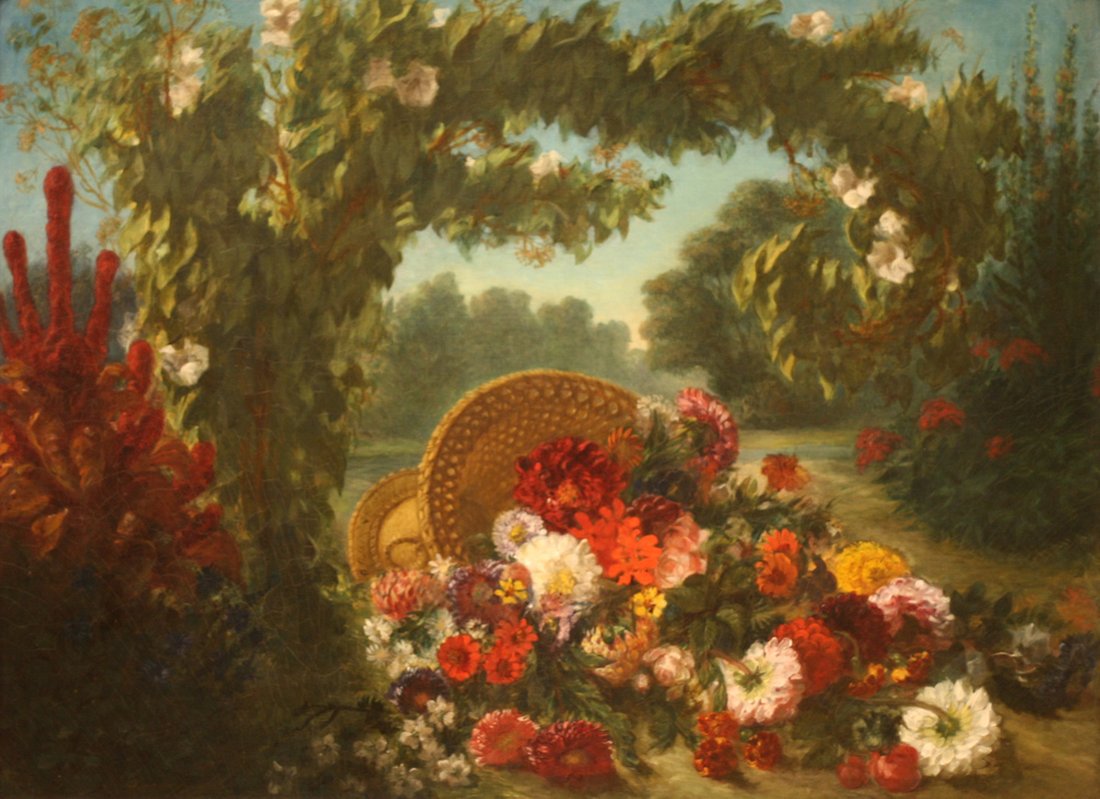

Neoclassicism and Romanticism, the great nineteenth-century quarrel
This room brings together canvases by Eugène Delacroix and Jean-Auguste-Dominique Ingres, the two figures who embody the great aesthetic divide of nineteenth-century French painting: the Neoclassicism inherited from David, which Ingres saw himself as continuing, against the Romanticism of which Delacroix became the leading figure. The rivalry between the two men did not crystallize at the Salons of 1824 or 1827-1828, as is often assumed, but built up more slowly, over the 1830s and 1840s, before reaching its peak at the 1855 Exposition Universelle.
1. Ingres: "a thing well drawn is always a thing well painted"
The Ingres portraits gathered here, such as Joseph-Antoine Moltedo or the Leblanc couple, show the precision of contour and near-photographic finish that made his reputation: for Ingres, line was painting's supreme virtue, a conviction he summed up in a now-famous phrase — a thing well drawn is always a thing well painted.
2. Delacroix: color as method
Delacroix, by contrast, developed a technique in which touches of pure color, laid side by side rather than mixed on the palette, blend optically in the viewer's eye — a method that pointillist painters such as Seurat would push further, in an almost scientific direction, a generation later. The contempt was mutual and personal: one anecdote has Ingres asking for the windows of the Louvre to be opened to air out the "smell of sulfur" a visit from Delacroix had supposedly left behind.
How much time
Move from one wall to the other comparing the brushwork directly: Ingres's crisp contour against Delacroix's colored glazes.
- Ingres's portraits — 10 minutes.
- Delacroix's canvases — 10 minutes.
Sources and verification
Checked against the official notices of the Metropolitan Museum of Art (metmuseum.org) and cross-checked with Wikipedia EN/FR.
- Oxford Academic — Ingres versus Delacroix (Art History)
- JSTOR Daily — Ingres vs Delacroix: An Artistic Rivalry Spills Over at a Party
- The Art Story — Eugène Delacroix
- The Art Story — Jean-Auguste-Dominique Ingres
Displays and room openings can change. Check the Metropolitan Museum of Art website on the day of your visit before following a route.
Continue your visit
Metropolitan Museum of Art, New York
Listen to the commentary in the gallery
This route gives you a thread to follow. In front of an artwork, CulturAll adds the audio commentary: photograph the work or its label, listen, then ask your questions.