

The world's oldest university museum
The Ashmolean Museum opened its doors on 24 May 1683, making it the oldest university museum in the world. Its founding collection is, however, half a century older than the building: it comes from the cabinet of curiosities the gardener and naturalist John Tradescant the Elder began assembling in the 1620s, which his son, John Tradescant the Younger, then opened to a paying public at their house in Lambeth, nicknamed "the Ark."
1. An ark of curiosities left to a stranger
In 1677, John Tradescant the Younger bequeathed his entire collection to Elias Ashmole, an antiquary, astrologer and collector he had known for several years. Ashmole in turn donated the whole collection to the University of Oxford, on the express condition that a building be constructed to house it — the foundation stone of the future museum was laid as early as 1679, before the bequest was even fully settled, and the collection's crates traveled up the Thames by barge from Lambeth to reach Oxford.
The portraits of John Tradescant the Elder and John Tradescant the Younger, hung in this room, show the two men behind this collection of curiosities that nothing, at the time, destined to become a university museum.
2. Ashmole, the name the museum carries
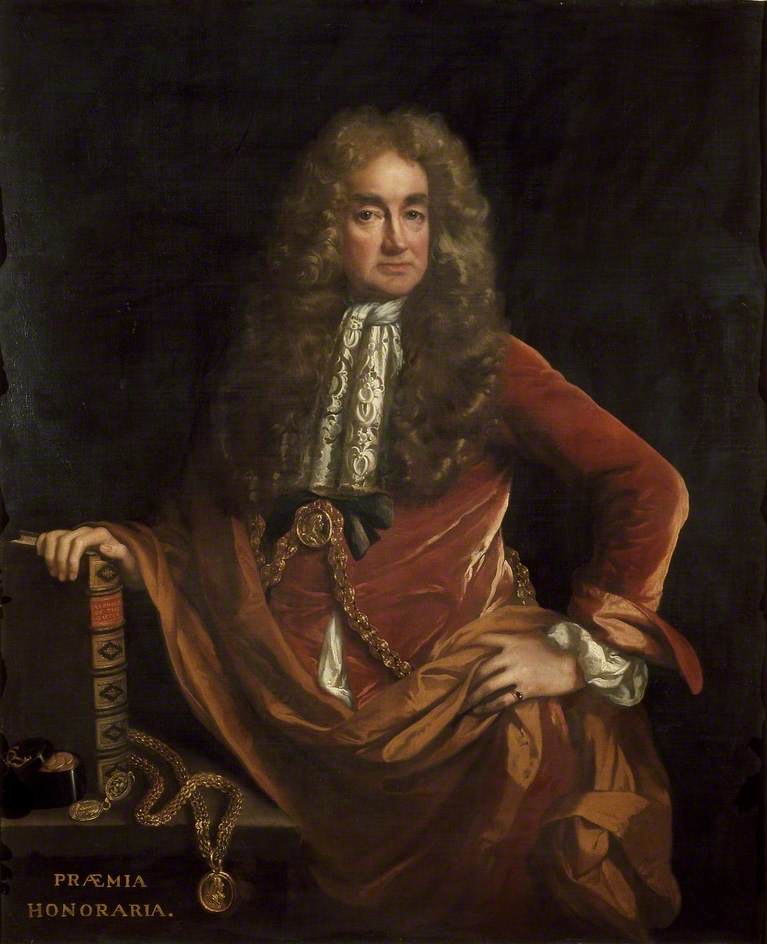
The portrait of Elias Ashmole himself, painted by John Riley around 1681-1682, shows the antiquary, astrologer and collector who gave the museum its name after donating his own collection, and the Tradescants', to the University of Oxford. Ashmole practised astrology throughout his life and assembled one of the largest English libraries on the subject — a passion that was, at the time, in no way at odds with his role as a learned collector.
3. Dee, Lilly and Plot, between astrology and emerging science
The portrait of John Dee, astrologer and mathematician at the court of Elizabeth I, and that of William Lilly, the most celebrated astrologer in seventeenth-century England, hang not far from Ashmole's — two figures who reflect his own interest in a discipline then taught alongside the natural sciences, with none of the sharp line drawn today between astrology and astronomy.
The portrait of Robert Plot, the museum's first keeper when it opened in 1683, completes this room: a naturalist and chemist by training, Plot embodies on his own the turning point between the fascination with the occult that drove Ashmole and the emerging scientific method that would gradually take hold of the museum's collections.
4. Two objects that built the museum's legend
The Guy Fawkes's Lantern, iron and horn, c. 1605, stands 34.5 cm high. Guy Fawkes is said to have been carrying it when he was arrested in the cellars beneath the Houses of Parliament on the night of 4-5 November 1605, during the Gunpowder Plot to assassinate King James I. Peter Heywood, who accompanied Sir Thomas Knyvett on the search of the cellars, is credited by the museum with wrestling the lantern from Fawkes, preventing him from detonating the gunpowder. Heywood's brother Robert presented the lantern to the University of Oxford in 1641; it hung for over two centuries in the Bodleian Library's Picture Gallery before entering the Ashmolean's founding collections in 1887.
Powhatan's Mantle, a deer-hide hanging decorated with shell beadwork, c. 1600-1638, measures 235 by 160 cm and was made in the southern Chesapeake Bay region, Virginia. Sewn from four white-tailed deer hides, it is decorated with a central human-like figure flanked by two animal figures, surrounded by thirty-four circles thought to represent Powhatan settlements or tribal nations. It is named for Wahunsenacawh (c. 1550-1618), paramount chief of the Powhatan Confederacy in what is now Virginia; the museum's most widely accepted theory is that it was among gifts presented by Powhatan in 1608 to Captain Christopher Newport for King James I. First recorded in the Tradescant collection in London in July 1638, it was presented to the Ashmolean by Elias Ashmole in 1677 along with the rest of the "Ark" — one of the founding objects of the museum's 1683 collection.
How much time
A short room but dense with names: take the time to work out who is who before moving on to the next rooms. Allow close to three quarters of an hour for the six portraits.
- John Tradescant the Elder — 8 minutes.
- John Tradescant the Younger — 8 minutes.
- Elias Ashmole — 9 minutes.
- John Dee — 7 minutes.
- William Lilly — 7 minutes.
- Robert Plot — 8 minutes.
- Guy Fawkes's Lantern — 7 minutes.
- Powhatan's Mantle — 6 minutes.
Sources and verification
Checked against the official notices of the Ashmolean Museum (ashmolean.org) and cross-checked with Wikipedia EN/FR.
- Ashmolean Museum — History of the Ashmolean
- Ashmolean Museum — The Ashmolean Story Gallery
- Ashmolean Museum — About: History & Future
- Britannica — John Tradescant
- Ashmolean Museum — Guy Fawkes's Lantern
- Ashmolean Museum — Powhatan's Mantle
Displays and room openings can change. Check the Ashmolean Museum website on the day of your visit before following a route.
Continue your visit
Ashmolean Museum, Oxford
Listen to the commentary in the gallery
This route gives you a thread to follow. In front of an artwork, CulturAll adds the audio commentary: photograph the work or its label, listen, then ask your questions.

