

A room for the museum's Venetian and Italian painting
This Fitzwilliam gallery brings together Italian paintings of the sixteenth and seventeenth centuries, from Sebastiano del Piombo to views of Venice by Canaletto and Bellotto — a setting that gives a Venetian context to the most dramatic painting in the room, painted by Titian right at the end of his life.
1. A rape painted by an artist past eighty
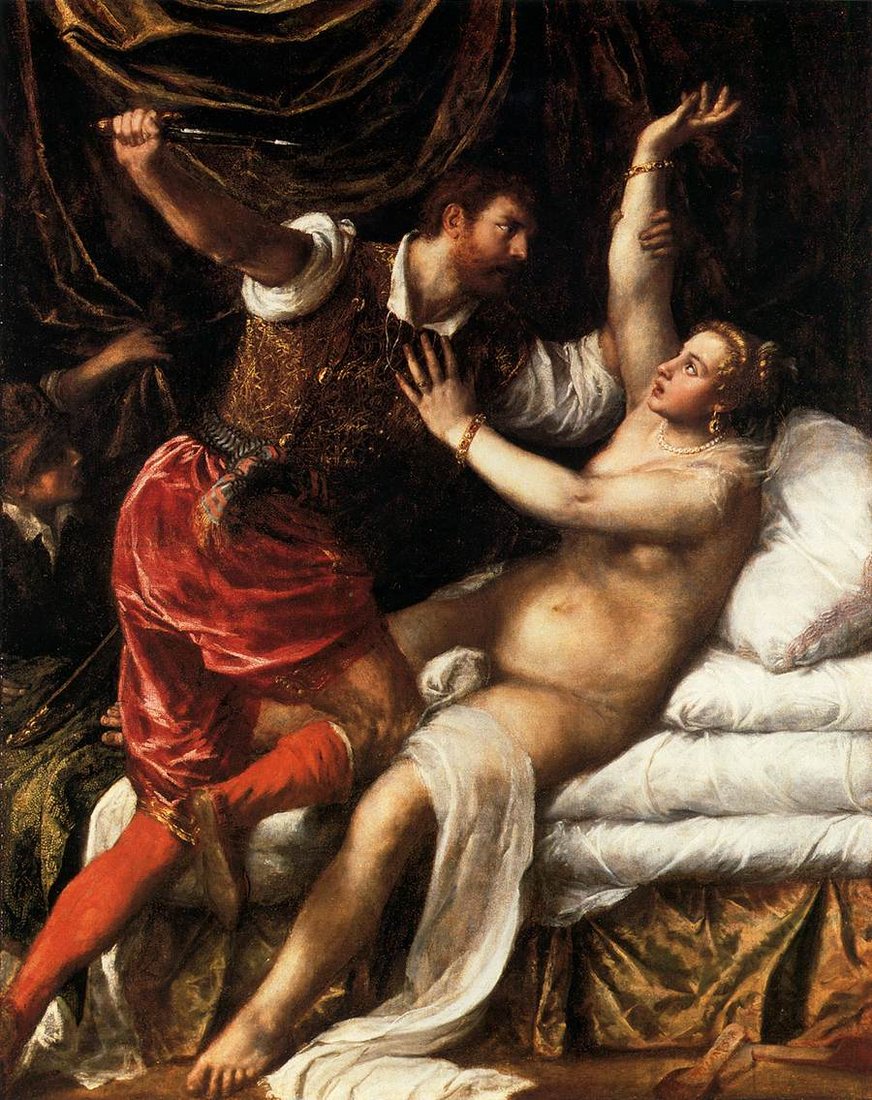
Tarquin and Lucretia, painted around 1571, shows the assault of Lucretia by Sextus Tarquinius, an episode from the Roman legend that precedes the founding of the Republic. Titian, then over eighty years old, returns to a subject he had already treated nearly sixty years earlier in a version now held in Vienna — but this time with a brutality and physical tension unusual in his late work. A composite X-ray analysis has revealed extensive compositional revisions, a sign of work still carefully reworked despite the painter's age.
2. From the Spanish royal collection to an anonymous "foreign nobleman"
The painting probably belonged to King Philip II of Spain from 1571, then remained in the Spanish royal collections until 1813, when Joseph Bonaparte, Napoleon's brother and deposed King of Spain, took it to France as he lost his throne. It later resurfaces in London, sold at Christie's in 1845 as the property of a mysterious "foreign nobleman" never identified in the sale catalogue.
The painting then changes hands several more times — the collectors C. J. Nieuwenhuys, William Coningham, Lord Northwick, Charles Scarisbrick, then Charles Butler, whose estate sale in 1911 passed it through the dealer Agnew's — before being given to the Fitzwilliam by the collector and painter Charles Fairfax Murray in 1918.
How much time
A single painting, but move in close: the revisions visible to the naked eye around the arms and drapery betray a work reworked more than once.
- Tarquin and Lucretia — 12 minutes.
- The rest of the room (Sebastiano del Piombo, Canaletto, Bellotto) — 10 minutes.
Sources and verification
Checked against the official notice of the Fitzwilliam Museum (fitzmuseum.cam.ac.uk / data.fitzmuseum.cam.ac.uk) and cross-checked with Wikipedia EN/FR.
- The Fitzwilliam Museum — Tarquin and Lucretia
- The Fitzwilliam Museum — Tarquin and Lucretia: object record and provenance
- Art UK — Tarquin and Lucretia, The Fitzwilliam Museum
- Wikipedia EN — Tarquin and Lucretia
Displays and room openings can change. Check the Fitzwilliam Museum website on the day of your visit before following a route.
Listen to the commentary in the gallery
This route gives you a thread to follow. In front of an artwork, CulturAll adds the audio commentary: photograph the work or its label, listen, then ask your questions.